How to Make Homemade Hummingbird Nectar
How to Make Homemade Hummingbird Nectar
This recipe makes one cup of nectar. You can increase the amounts if you need a larger portion.
1. Measure out 1/4 cup of plain white sugar in a microwave safe bowl.
IMPORTANT: Do not use honey, molasses or sugar substitutes. These are not safe for the birds.
2. Add one cup water. (If you are increasing the recipe, you want 1 part sugar to 4 parts water.)
3. Microwave for 2-3 minutes or until boiling. Mix well until the sugar is dissolved.
4. Let the mixture cool completely before filling your feeder.
5. Enjoy watching the hummers sip the glorious nectar in your garden!


The best thing I have EVER done for the hummingbirds in my garden

I knew how to make some good formula to put in the feeder and I had a good feeder, but my knowledge was pretty limited. I was actually able to successfully attract hummingbirds to my feeder at one point, so I didn’t know that I was doing some stuff wrong.
I can’t remember when it happened exactly, but one day, they just stopped feeding in my yard. I had the formula right and I had the right type of feeder, so I thought I was doing everything right.
I recently came across a guide about attracting and feeding hummingbirds in your garden called Hummingbirds at Home . Since getting the guide a few days ago, I have read it 3 times through – no joke.
Hummingbirds at Home is by far the best hummingbird guide I have ever read. “The best”, meaning: great facts and tips about different hummingbird species and their behavior, things to avoid when setting up a feeder, things to keep in mind when attracting hummingbirds to your garden, things to do to make the hummingbirds want to come back every single day, and much much more.
Obviously I can’t spill everything here, but my point is that after reading this guide, I was totally shocked as to how many mistakes I used to make when doing this.
I am giving this guide my highest recommendation because I absolutely know that after reading it, you will be as enlightened as I was when I finished reading it.
Visit Hummingbirds at Home to get instant access to the guide and start attracting more hummingbirds to your garden today.
hummingbird feeders
Hummingbirds get the energy they need to maintain their astonishing metabolism primarily from flower nectar and the sugar water they find at feeders (here's the recipe). For protein and other nutrients, they also eat soft-bodied insects and spiders; I like Bob Sargent's perspective: "Hummers need nectar to power the bug eating machine that they are." Think of them as miniature flycatchers, and sugar is just the fuel for getting their real nourishment. You might try setting out some overripe fruit--banana peels are good--to attract flies for your hummers. If you have developed a particularly entertaining method of providing bugs for their dining pleasure, I'd be more than happy to publish it here. :-) Meanwhile, let's talk about nectar feeders, some of which are reviewed on another page.
A Little History...
The device pictured at left is an example of the first commercially-available hummingbird feeder. It was designed by Laurence J. Webster of Boston for his wife, who had read a 1928 National Geographic story about feeding hummers from small glass bottles. Sometime between 1929 and 1935, Webster had his design produced by an MIT lab glassblower (possibly James Ryan). In 1947, National Geographic ran an article by Harold Edgerton about his newly-invented strobe flash, which included photos of hummingbirds at Webster's feeder. Interest was aroused, and in 1950 the Webster feeder was offered for sale by the Audubon Novelty Company of Medina, NY.
Choosing a Feeder
There are many imaginatively-styled hummingbird feeders available today, and they're sold in stores ranging from birding shops and garden centers to discount marts, as well as by mail order. Most feeders are made of plastic, glass, and/or ceramics. Since feeders are much too recent a development for hummingbirds to recognize instinctively as food sources, they must learn to use them, which they do from watching other hummers and though their own natural inquisitiveness. If your birds seem to prefer one style feeder over another, it's probably a simple matter of familiarity. If you change feeders, they may not feed immediately from the new one, but they will adapt; it may help to hang the old feeder, empty, next to the new one.
Any feeder can attract hummers, so perhaps the most important design feature to look for is ease of disassembly and cleaning. In this respect, the basin-style feeders are much, much better than the inverted-bottle types. I recommend the HummZinger and similar well-designed basin feeders for their ruggedness as well as their ease of maintenance. Hummingbirds will come to any feeder that holds fresh syrup, so you might as well buy one that's easy for you to keep up - if it's easy, you're more likely to do it faithfully, and that's important.
Should you buy a feeder with perches? Many photographers prefer not to use perches, because they can get better pictures of hovering birds. But hummers live at the edges of their energy envelopes, and perching saves a lot of calories. Consider that when hummingbirds feed from natural flowers, they spend very little time at any one blossom; on the other hand, they may drink from one feeder port until they are satiated, and hovering is considerably more tiring to them than normal flight. Give them a break, and provide a place for them to rest. After all, many hummingbirds spend around 80% of their time perching anyway, on twigs and leaf stems.
Location, Location, Location
Where to hang your feeder? A new one may be found sooner if hung over or near a garden of hummingbird plants. My feeders are near windows, where I can watch and enjoy them: one is in a living room window, another outside the kitchen, and a third hangs a foot or so from my office window.
Some people feel that a hummingbird feeder should not be placed close to a window unless there's a drawn curtain or blind behind it, to avoid injury from striking the glass. Other ways to alert birds that the window is not a clear flyway are to add cutouts of predatory birds, windsocks, or decorative flags (on the outside). I've never had a hummer strike my windows (although a few have been pushed bodily into the glass by aggressive territory defenders), and I have mini-blinds that seem to be a good deterrent even when tilted open.
Filling the Feeder
The sugar water we use to fill hummingbird feeders is only a supplement to the birds' natural diet. It's not necessary to buy a commercial "nectar" mix that includes additional vitamins, protein, or other substances, because the birds get all they need from the flower nectar and insects they consume. All they want from us is the quick energy they get from ordinary white cane sugar. It's just fuel for chasing bugs, and causes no known health problems in hummingbirds, whose metabolism is significantly different from humans'.
A note about sugars: natural nectars may contain any of the plant sugars, including sucrose, glucose, and fructose. There is no proven advantage in using, say, fructose instead of sucrose (cane or beet sugar). In fact, given the choice, hummingbirds seem to prefer sucrose above all others. Sucrose is by far the most common sugar in the flowers of plants for which hummingbirds are the primary pollenators. Water and sugar (usually sucrose) are the only constituents common to all natural nectars; most also contain traces of minerals and amino acids, but they vary from plant to plant, and probably are of little dietary importance.
What about beet sugar? I have read anecdotal evidence that hummingbirds can taste the difference between cane and beet sugars, and at least sometimes will reject beet sugar completely. If you can't seem to attract hummers and are using white sugar that's not specifically labeled as cane, try changing to a brand that is.
Americans can't use raw sugar, because its sale is banned in the U.S. due to diverse and unpredictable impurities (bacteria, molds, heavy metals, rat excrement, insect parts, etc.). The so-called "raw" sugar (also known as turbinado) common in third-world countries and marketed by health food stores is actually refined by the same process as white sugar, but without removing all of the molasses and other non-sugar components. The result is a less-pure sucrose that contains about five times as much iron as white sugar; since iron is essential but normally rare in hummingbird diets, their bodies hoard it, and even a modest excess of iron can poison them. If you have the choice, use only white sugar in hummingbird feeders.
Here is an article by Penny Elliston, a licensed hummingbird rehabilitator, about the dangers of relying too heavily on commercial mixes.
Please, do not put honey, Jell-O, brown sugar, fruit, or red food coloring in your feeder! Honey ferments rapidly when diluted with water and can kill hummingbirds. The effects of red dye have not been not scientifically tested, and it is not necessary to color the water to attract birds to your feeder. Further, there are unverified reports that red dye can cause tumors in hummingbirds; this may or may not be true, but why take the chance?
Here's the recipe for artificial nectar (syrup):
Use one part ordinary white cane sugar to four parts water.
It's not necessary to boil the water. The microorganisms that cause fermentation don't come from the water; they are transported to the feeder on hummingbird bills.
Store unused syrup in the refrigerator for up to two weeks.
This mixture approximates the average sucrose content (about 21%) of the flowers favored by North American hummingbirds, without being so sweet it attracts too many insects.
Distilled water may be used instead of tapwater. However, some researchers are concerned that distilled water lacks minerals that hummingbirds need, and believe it would be prudent to add a pinch of sodium-free salt, which contain potassium chloride, to feeder solutions made with distilled or demineralized water. This should help bring the salt content of artificial nectar back in line with that of natural nectar and help prevent electrolyte deficiencies. Do not use table salt (sodium chloride). Adding salt is not necessary if well or tap water is used.
Any syrup solution will spoil eventually, regardless of temperature, so strict maintenance is required (see below).
For the sake of completeness: another view of syrup concentration appeared in the May 1993 article by Reed Hainsworth and Larry Wolf, both noted hummingbird researchers. However, it's not clear that the health of the birds was considered, or merely their preferences - like children, hummers may tend to eat more candy than is good for them - and there is still a suspicion that high sugar concentrations can cause liver damage in hummingbirds. When I wrote Dr. Hainsworth asking for a reference to a more rigorously-scientific treatment of his data (i.e., a published paper), his reply dodged the question. Without reflection upon anyone's reputation, I stand by the opinion of the majority of hummingbird researchers, that a 1:4 mixture has been shown to do no harm, and any other formula must remain suspect.
There are some specialized protein-added hummingbird food mixtures (e.g., Nektar Plus) that are useful in laboratory or rehabilitation settings, where no natural food is available, or possibly in emergency winter situations when hummingbirds will die without it. But realize that these mixtures are especially vulnerable to spoiling and in an ordinary feeder setting during warm weather would need to be changed every few hours.
Feeder Maintenance
Hanging a hummingbird feeder means assuming a certain amount of responsibility for the well-being of a fragile and trusting animal. If you are not prepared to follow the rigorous maintenance routine outlined below, perhaps you should consider planting a hummingbird garden, instead.
Cleaning
Experts tell me that hummingbirds will starve rather than consume spoiled feeder syrup, so a dirty feeder isn't likely to cause harm. But it may cost you the pleasure of their company if they abandon your yard for more reliable food sources elsewhere.
Every filling, flush the feeder with hot tap water; a bottle brush can be very helpful. Do not use soap - hummers apparently don't like the taste, but bleach will remove it if you have this problem. Visually inspect the entire feeder for black mold; a bleach soak (see the next paragraph) is the best way to remove mold. Discard any unconsumed sugar water - if the birds are not emptying your feeder between cleanings, just partially refill it. If the sugar solution in your feeder turns cloudy, it's spoiled and needs to be replaced. This can happen in as little as two days.
At least once a month, clean the feeder thoroughly with a solution of 1/4 cup bleach to one gallon of water. Soak the feeder in this solution for one hour, then clean with a bottle brush. Rinse well with running water and refill. Any remaining traces of bleach will be neutralized by reacting with the fresh syrup, and there's no need to air dry before refilling. Bleach is both safe and very effective.
These is evidence that bleach accelerates leaching of BPA (a chemical known to cause genetic damage in mammals) from polycarbonate plastic. No one, as far as I know, has studied its effects on birds. If you are concerned about BPA, use full-strength white vinegar instead of bleach.
When to Take Down the Feeder
Hummingbirds will not delay migration if a feeder is present; they are driven by forces more powerful than hunger. If you live in the southeastern U.S., leaving a feeder up might attract one of the western hummers that visit the region in small numbers every winter. The Pacific coast of the U.S. (and extreme southwestern Canada) has a population of non-migratory Anna's Hummingbirds; if a feeder is maintained over the winter, hummers will visit it year-round. Some other locations near the Mexican border also have winter populations of several hummingbird species. See the About Hummingbirds section for more information.
Ants
They will find your feeder, unless you take precautions. Buy a dripless feeder; they really make a difference. Some feeder models feature a built-in ant moat that may be filled with water; don't use oil, since chickadees and other small birds like to drink from ant moats. You can make your own moat by running the hang wire through a hole in a spraycan top (use a dab of silicone sealer or hot glue to seal the hole). But the best defense against ants is to paint the inside bottom of an ant moat with Tanglefoot, a very sticky goo sold at nurseries, and install the moat open side down. This is extremely effective against ants, poses no risk of a bird getting stuck or contaminated, and is low maintenance, since it keeps the goo from being compromised by rain and dust. If you use Tanglefoot, or any other sticky or oily substance, you must be absolutely sure it cannot come into contact with a bird.
I no longer recommend using duct tape or castor oil around suction cups or on hang wires. There's too much chance of a hummer brushing against it during feeder fights.
Bees, Wasps, and Yellowjackets
It was recently discovered that bees and wasps are attracted to the color yellow. Since many hummingbird feeders have yellow plastic "flowers" or other parts, try removing such parts or painting them red before hanging your feeder in the spring - once bees learn where food is, they fly right back to the hive to tell all their friends, so avoiding their attention up front works best.
You can buy a feeder with bee guards. However, those tend to be the drippiest feeders available (Perky-Pet "Four Flowers," etc.), and once they start dripping the bee guards are useless, since puddles form in the flowers outside of the bee guards, an easy meal for insects.
The only sure defense against bees and wasps is to absolutely deny them access to the syrup. In June 1997 I replaced my Perky-Pet 210-P with a HummZinger, which is inherently wasp-proof because the syrup level is too low for insects to reach, but easily in range of the shortest hummingbird tongue. I also bought a Perky-Pet Oasis feeder, a copy of the HummZinger with several design flaws, but just as effective against bees. Rubbermaid makes an inexpensive basin-type feeder that can be hung or suction-cupped to a window. Basin feeders are also available from Opus and other companies, and all are effective in denying food to bees and wasps. All are also easy to clean.
If you choose not to try a new feeder and wasps persist, first try moving the feeder, even just a few feet; insects are not very smart, and will assume the food source is gone forever. They may never find it in its new location, while the hummers will barely notice that it was moved. If that doesn't work, take the feeder down for a day, or until you stop seeing wasps looking for it. You'll see hummers looking for it, too, but they won't give up nearly as soon as the wasps. Also, reducing the sugar concentration to 1 part sugar in 5 parts water will make it less attractive to insects, but probably won't make the hummingbirds lose interest.
A Little History...
The device pictured at left is an example of the first commercially-available hummingbird feeder. It was designed by Laurence J. Webster of Boston for his wife, who had read a 1928 National Geographic story about feeding hummers from small glass bottles. Sometime between 1929 and 1935, Webster had his design produced by an MIT lab glassblower (possibly James Ryan). In 1947, National Geographic ran an article by Harold Edgerton about his newly-invented strobe flash, which included photos of hummingbirds at Webster's feeder. Interest was aroused, and in 1950 the Webster feeder was offered for sale by the Audubon Novelty Company of Medina, NY.
Choosing a Feeder
There are many imaginatively-styled hummingbird feeders available today, and they're sold in stores ranging from birding shops and garden centers to discount marts, as well as by mail order. Most feeders are made of plastic, glass, and/or ceramics. Since feeders are much too recent a development for hummingbirds to recognize instinctively as food sources, they must learn to use them, which they do from watching other hummers and though their own natural inquisitiveness. If your birds seem to prefer one style feeder over another, it's probably a simple matter of familiarity. If you change feeders, they may not feed immediately from the new one, but they will adapt; it may help to hang the old feeder, empty, next to the new one.
Any feeder can attract hummers, so perhaps the most important design feature to look for is ease of disassembly and cleaning. In this respect, the basin-style feeders are much, much better than the inverted-bottle types. I recommend the HummZinger and similar well-designed basin feeders for their ruggedness as well as their ease of maintenance. Hummingbirds will come to any feeder that holds fresh syrup, so you might as well buy one that's easy for you to keep up - if it's easy, you're more likely to do it faithfully, and that's important.
Should you buy a feeder with perches? Many photographers prefer not to use perches, because they can get better pictures of hovering birds. But hummers live at the edges of their energy envelopes, and perching saves a lot of calories. Consider that when hummingbirds feed from natural flowers, they spend very little time at any one blossom; on the other hand, they may drink from one feeder port until they are satiated, and hovering is considerably more tiring to them than normal flight. Give them a break, and provide a place for them to rest. After all, many hummingbirds spend around 80% of their time perching anyway, on twigs and leaf stems.
Location, Location, Location
Where to hang your feeder? A new one may be found sooner if hung over or near a garden of hummingbird plants. My feeders are near windows, where I can watch and enjoy them: one is in a living room window, another outside the kitchen, and a third hangs a foot or so from my office window.
Some people feel that a hummingbird feeder should not be placed close to a window unless there's a drawn curtain or blind behind it, to avoid injury from striking the glass. Other ways to alert birds that the window is not a clear flyway are to add cutouts of predatory birds, windsocks, or decorative flags (on the outside). I've never had a hummer strike my windows (although a few have been pushed bodily into the glass by aggressive territory defenders), and I have mini-blinds that seem to be a good deterrent even when tilted open.
Filling the Feeder
The sugar water we use to fill hummingbird feeders is only a supplement to the birds' natural diet. It's not necessary to buy a commercial "nectar" mix that includes additional vitamins, protein, or other substances, because the birds get all they need from the flower nectar and insects they consume. All they want from us is the quick energy they get from ordinary white cane sugar. It's just fuel for chasing bugs, and causes no known health problems in hummingbirds, whose metabolism is significantly different from humans'.
A note about sugars: natural nectars may contain any of the plant sugars, including sucrose, glucose, and fructose. There is no proven advantage in using, say, fructose instead of sucrose (cane or beet sugar). In fact, given the choice, hummingbirds seem to prefer sucrose above all others. Sucrose is by far the most common sugar in the flowers of plants for which hummingbirds are the primary pollenators. Water and sugar (usually sucrose) are the only constituents common to all natural nectars; most also contain traces of minerals and amino acids, but they vary from plant to plant, and probably are of little dietary importance.
What about beet sugar? I have read anecdotal evidence that hummingbirds can taste the difference between cane and beet sugars, and at least sometimes will reject beet sugar completely. If you can't seem to attract hummers and are using white sugar that's not specifically labeled as cane, try changing to a brand that is.
Americans can't use raw sugar, because its sale is banned in the U.S. due to diverse and unpredictable impurities (bacteria, molds, heavy metals, rat excrement, insect parts, etc.). The so-called "raw" sugar (also known as turbinado) common in third-world countries and marketed by health food stores is actually refined by the same process as white sugar, but without removing all of the molasses and other non-sugar components. The result is a less-pure sucrose that contains about five times as much iron as white sugar; since iron is essential but normally rare in hummingbird diets, their bodies hoard it, and even a modest excess of iron can poison them. If you have the choice, use only white sugar in hummingbird feeders.
Here is an article by Penny Elliston, a licensed hummingbird rehabilitator, about the dangers of relying too heavily on commercial mixes.
Please, do not put honey, Jell-O, brown sugar, fruit, or red food coloring in your feeder! Honey ferments rapidly when diluted with water and can kill hummingbirds. The effects of red dye have not been not scientifically tested, and it is not necessary to color the water to attract birds to your feeder. Further, there are unverified reports that red dye can cause tumors in hummingbirds; this may or may not be true, but why take the chance?
Here's the recipe for artificial nectar (syrup):
Use one part ordinary white cane sugar to four parts water.
It's not necessary to boil the water. The microorganisms that cause fermentation don't come from the water; they are transported to the feeder on hummingbird bills.
Store unused syrup in the refrigerator for up to two weeks.
This mixture approximates the average sucrose content (about 21%) of the flowers favored by North American hummingbirds, without being so sweet it attracts too many insects.
Distilled water may be used instead of tapwater. However, some researchers are concerned that distilled water lacks minerals that hummingbirds need, and believe it would be prudent to add a pinch of sodium-free salt, which contain potassium chloride, to feeder solutions made with distilled or demineralized water. This should help bring the salt content of artificial nectar back in line with that of natural nectar and help prevent electrolyte deficiencies. Do not use table salt (sodium chloride). Adding salt is not necessary if well or tap water is used.
Any syrup solution will spoil eventually, regardless of temperature, so strict maintenance is required (see below).
For the sake of completeness: another view of syrup concentration appeared in the May 1993 article by Reed Hainsworth and Larry Wolf, both noted hummingbird researchers. However, it's not clear that the health of the birds was considered, or merely their preferences - like children, hummers may tend to eat more candy than is good for them - and there is still a suspicion that high sugar concentrations can cause liver damage in hummingbirds. When I wrote Dr. Hainsworth asking for a reference to a more rigorously-scientific treatment of his data (i.e., a published paper), his reply dodged the question. Without reflection upon anyone's reputation, I stand by the opinion of the majority of hummingbird researchers, that a 1:4 mixture has been shown to do no harm, and any other formula must remain suspect.
There are some specialized protein-added hummingbird food mixtures (e.g., Nektar Plus) that are useful in laboratory or rehabilitation settings, where no natural food is available, or possibly in emergency winter situations when hummingbirds will die without it. But realize that these mixtures are especially vulnerable to spoiling and in an ordinary feeder setting during warm weather would need to be changed every few hours.
Feeder Maintenance
Hanging a hummingbird feeder means assuming a certain amount of responsibility for the well-being of a fragile and trusting animal. If you are not prepared to follow the rigorous maintenance routine outlined below, perhaps you should consider planting a hummingbird garden, instead.
Cleaning
Experts tell me that hummingbirds will starve rather than consume spoiled feeder syrup, so a dirty feeder isn't likely to cause harm. But it may cost you the pleasure of their company if they abandon your yard for more reliable food sources elsewhere.
Every filling, flush the feeder with hot tap water; a bottle brush can be very helpful. Do not use soap - hummers apparently don't like the taste, but bleach will remove it if you have this problem. Visually inspect the entire feeder for black mold; a bleach soak (see the next paragraph) is the best way to remove mold. Discard any unconsumed sugar water - if the birds are not emptying your feeder between cleanings, just partially refill it. If the sugar solution in your feeder turns cloudy, it's spoiled and needs to be replaced. This can happen in as little as two days.
At least once a month, clean the feeder thoroughly with a solution of 1/4 cup bleach to one gallon of water. Soak the feeder in this solution for one hour, then clean with a bottle brush. Rinse well with running water and refill. Any remaining traces of bleach will be neutralized by reacting with the fresh syrup, and there's no need to air dry before refilling. Bleach is both safe and very effective.
These is evidence that bleach accelerates leaching of BPA (a chemical known to cause genetic damage in mammals) from polycarbonate plastic. No one, as far as I know, has studied its effects on birds. If you are concerned about BPA, use full-strength white vinegar instead of bleach.
When to Take Down the Feeder
Hummingbirds will not delay migration if a feeder is present; they are driven by forces more powerful than hunger. If you live in the southeastern U.S., leaving a feeder up might attract one of the western hummers that visit the region in small numbers every winter. The Pacific coast of the U.S. (and extreme southwestern Canada) has a population of non-migratory Anna's Hummingbirds; if a feeder is maintained over the winter, hummers will visit it year-round. Some other locations near the Mexican border also have winter populations of several hummingbird species. See the About Hummingbirds section for more information.
Ants
They will find your feeder, unless you take precautions. Buy a dripless feeder; they really make a difference. Some feeder models feature a built-in ant moat that may be filled with water; don't use oil, since chickadees and other small birds like to drink from ant moats. You can make your own moat by running the hang wire through a hole in a spraycan top (use a dab of silicone sealer or hot glue to seal the hole). But the best defense against ants is to paint the inside bottom of an ant moat with Tanglefoot, a very sticky goo sold at nurseries, and install the moat open side down. This is extremely effective against ants, poses no risk of a bird getting stuck or contaminated, and is low maintenance, since it keeps the goo from being compromised by rain and dust. If you use Tanglefoot, or any other sticky or oily substance, you must be absolutely sure it cannot come into contact with a bird.
I no longer recommend using duct tape or castor oil around suction cups or on hang wires. There's too much chance of a hummer brushing against it during feeder fights.
Bees, Wasps, and Yellowjackets
It was recently discovered that bees and wasps are attracted to the color yellow. Since many hummingbird feeders have yellow plastic "flowers" or other parts, try removing such parts or painting them red before hanging your feeder in the spring - once bees learn where food is, they fly right back to the hive to tell all their friends, so avoiding their attention up front works best.
You can buy a feeder with bee guards. However, those tend to be the drippiest feeders available (Perky-Pet "Four Flowers," etc.), and once they start dripping the bee guards are useless, since puddles form in the flowers outside of the bee guards, an easy meal for insects.
The only sure defense against bees and wasps is to absolutely deny them access to the syrup. In June 1997 I replaced my Perky-Pet 210-P with a HummZinger, which is inherently wasp-proof because the syrup level is too low for insects to reach, but easily in range of the shortest hummingbird tongue. I also bought a Perky-Pet Oasis feeder, a copy of the HummZinger with several design flaws, but just as effective against bees. Rubbermaid makes an inexpensive basin-type feeder that can be hung or suction-cupped to a window. Basin feeders are also available from Opus and other companies, and all are effective in denying food to bees and wasps. All are also easy to clean.
If you choose not to try a new feeder and wasps persist, first try moving the feeder, even just a few feet; insects are not very smart, and will assume the food source is gone forever. They may never find it in its new location, while the hummers will barely notice that it was moved. If that doesn't work, take the feeder down for a day, or until you stop seeing wasps looking for it. You'll see hummers looking for it, too, but they won't give up nearly as soon as the wasps. Also, reducing the sugar concentration to 1 part sugar in 5 parts water will make it less attractive to insects, but probably won't make the hummingbirds lose interest.
What Does a Hummingbird Nest Look Like and Where Is It?

Ruby-throated Hummingbirds
When do hummingbirds build nests?
In general, hummingbirds mate and nest at the times of year when flower blossoms are abundant, although in tropical areas where food is available year round, the breeding season is less predictable. Hummingbird nests are built and tended by the female birds – after mating, the male has no further responsibilities toward reproduction.
Where do hummingbirds build their nests?
Many people have had the good fortune to notice a hummingbird building a nest and rearing young in bushes or trees on their property. For the rest of us, however, the hummingbird nest is likely to be a complete mystery.
To find a hummingbird nest, start looking near a water source. Humidity is important for the development of the embryo inside the egg, so the birds prefer to build near rivers, streams, ponds and lakes. Many species nest near a reliable food supply, so there should be abundant blossoms in the area. At the same time, the nest will be protected from rainfall and direct sunlight, so it’s likely to be tucked away and difficult to spot.
Female hummingbirds are thought to check the strength of a prospective nest site by clinging to it or repeatedly landing on it. If the site passes the test, a female will begin to build – on the underside of a palm leaf, on the side of a vertical plant stem, on a small branch, on top of a cactus – many different locations are used and different species have different preferences. The typical hummingbirds usually build on branches, while the hermit hummingbirds build nests that hang from vegetation or from a vertical plant stem, root, or rock.
The height of a hummingbird nest from the ground varies greatly, even within a single species. Some build very near the ground, or even in caves, while other nest in the canopy.
What does a hummingbird nest look like?
Most typical hummingbirds build cup-shaped nests like the bird’s nests most of us are familiar with. Hermits build cone-shaped nests which hang vertically, attached to something strong enough to support the weight of nest and birds for the breeding season. Hummingbird nests are built with pieces of plants and often cobwebs, and females frequently need to repair the nest as the chicks grow.
A hummingbird usually lays two white eggs, which hatch within three weeks. Hungry nestlings may be seen reaching for the food their mother has brought – the chicks open their mouths in response to air currents created by the beating of her wings. Between three and four weeks after hatching, they’ll be gone.
Where Do Hummingbirds Sleep?(homemade hummingbird nectar)
Yes, hummingbirds do sleep. They do so at night by entering into a state known as torpor, which is a state similar to hibernation. Hummingbirds must enter this state to ensure that the birds won't actually starve to death before down. Torpor is a type of deep hummingbirds sleep where an animal lowers its hart and metabolic rate. In a state of torpor the hummingbird sleep lowers its metabolic rate by as much as 95%. A torpid hummingbird consumes up to 50 times less energy than when hummingbird not sleep. The lowered metabolic rate also causes a cooled body temperature. A hummingbirds sleep body temperature is maintained at a level which is barely sufficient to maintain life. This level is known as their set point and it is far below the normal daytime body temperature of 104°F or 40°C known for other birds of similar size.
There are many reasons why the hummingbird sleep must enter into a state of torpor. Hummingbirds are among the smallest of all warm-blooded animals, and they also lack the insulating downy feathers that are typical for many other bird species. Due to their small body size and lack of insulation, hummingbirds rapidly lose body heat to their surroundings. Even sleeping hummingbirds have huge metabolic demands that must be met in order for them to simply survive the night when they cannot forage. By entering into a state of torpor, a hummingbird sleep is able to save enough energy to survive cold nights by lowering their internal thermostat.
There are several types of torpor. The various types of torpor are classified mostly by duration and season. If the state of torpor takes place over a long period of time during the winter, it is known as hibernation. However, unlike hibernation, hummingbird sleep torpor can occur on any night of the year so it is referred to as daily torpor or noctivation.
Hummingbirds are not the only birds known to enter into a state of torpor. Other birds that are known to enter into a state of torpor include swallows and swifts. Scientists think that most small birds living in cold regions, such as chickadees, rely on torpor to survive long cold nights. Rodents, bats and other small mammals typically show some form of regulated hypothermia during cold weather, and these animals can only rely upon daily torpor during the winter months when they are not breeding. For hummingbirds, noctivation is possible on any night of the year.
The ability of the hummingbird sleep by entering into the state of torpor literally saves the birds life. The ability to enter into hummingbird sleep will literally prevent it from starving to death before dawn. Isn’t it amazing how nature provides each species of animal the ability to help insure its own survival?
Make your own homemade hummingbird nectar!.its easy
Make your own homemade hummingbird nectar!.its easy
Garden bird baths - Copper bird baths, Stone bird baths, solar bird baths
The need for a water source throughout the year is so strong that many different types of bird that do not visit seed feeders will show up just for the water.
When considering adding water there are a few different options that you may wish to consider: the water source or location, circulating the water, and providing a heat source for the water during colder times of the year to prevent it from freezing.
Bird Bath or Pond - A bird bath is a quick way to add water to your garden.
During warmer times of the year, birds may appreciate water more while in the shade, yet in cooler times of the year the water may be more attractive with some warm sunlight beating down on their feathers!
Both bird baths and ponds require regular routine maintenance. Bird Baths need regular cleaning and it is beneficial to add a product that acts as a protector that prevents stains, organic contaminants and mineral deposits as well as keep water clean and naturally clear.
Water Fountain / Dripper / Water Wiggler – Moving water keeps water cleaner for a longer period of time, attracts the attention of the birds, and prevents mosquitoes from making the water source as their home. A Water Fountain is usually self contained, whereas a Dripper will usually be added to an already existing bird bath. Each has the benefit of adding to your garden décor and recycles the water within the water fountain or bird bath.
Heated Water Sources - During the winter water becomes scarce, primarily because the usual water sources have two factors not working in the birds favor. Either their usual water source is frozen, and/or excessive amounts of snow can cover the water. The bird then spends enormous amounts of energy searching for water – energy that could be better spent trying to survive the winter cold.
Adding a heated water source to your wildlife sanctuary is something that will be very much appreciated by your feathered friends and you will be providing the greatest resource that birds need in order to survive.
When using a heated bird bath, make sure that your power source is safe.
During the summer, simply unplug your electrical source and use the heated bird bath / pond in its normal fashion.
Oklahoma’s Hummingbirds
Oklahoma’s smallest birds are the only birds that can fly backward, forward, upside down and hover. They average 3.5 inches in length a weigh the equivalent of a penny. Their wing muscles are proportionally larger than another other bird species. They use them to beat their wings 70 times a second while hovering.
Hummingbirds belong to a group of birds called neotropical migrants. The state’s tiniest visitors fly 500 miles across the Gulf of Mexico two times each year as they travel between North America and Mexico/Central America.
Four species of hummingbird visit Oklahoma.


Ruby-throated Hummingbird: The most common and widespread in Oklahoma. This species nests in the state.
Black-chinned Hummingbird: Seen in the far western part of Oklahoma and known to nest there. The species is nesting in larger numbers over a larger portion of the state, however. It may also be seen statewide at feeders during fall migration.
Rufous Hummingbird: Occasionally sighted at feeders during fall migration.
Broad-tailed Hummingbird: Rare visitors to western Oklahoma. They are rarely sighted elsewhere in the state.
Hummingbirds belong to a group of birds called neotropical migrants. The state’s tiniest visitors fly 500 miles across the Gulf of Mexico two times each year as they travel between North America and Mexico/Central America.
Four species of hummingbird visit Oklahoma.


Ruby-throated Hummingbird: The most common and widespread in Oklahoma. This species nests in the state.
Black-chinned Hummingbird: Seen in the far western part of Oklahoma and known to nest there. The species is nesting in larger numbers over a larger portion of the state, however. It may also be seen statewide at feeders during fall migration.
Rufous Hummingbird: Occasionally sighted at feeders during fall migration.
Broad-tailed Hummingbird: Rare visitors to western Oklahoma. They are rarely sighted elsewhere in the state.
The Effect of Floral Abundance on Feeder Censuses of Hummingbird Populations
Introduction
Many bird populations vary in size from year to year (e.g., Mulvihill and Leberman 1987), or even within years. In some cases this variation can be ascribed to particular environmental or demographic variables. For example, droughts may affect reproduction and survivorship through an effect on food resources (Gibbs and Grant 1987, Grant and Grant 1989), cold temperatures may result in decreased winter survivorship, or small population sizes may result in local extinctions. However, variation in population size usually remains unexplained.Hummingbird numbers seem to vary considerably, as perceived by numbers at feeders. Apparent lows are popularly attributed to environmental catastrophes on the wintering grounds for many species in Central America, such as volcanic eruptions, forest fires, and the use of pesticides. While these perceptions lack the rigor of scientific methodology, casual observations by numerous individuals nevertheless suggest that these are plausible explanations. Accurate estimates of hummingbird population size would permit more careful consideration of the significance of this variation.
A variety of techniques can be used to assess population size. Banding offers an advantage over techniques based on visual sightings, or counts of song or flight noise that may be conducted more easily, in that individuals are identified and counted only once. We have carried out long-term studies using two methods, banding and flight noise, on a resident population of Broad-tailed Hummingbirds (Selasphorus platycercus Swainson). During our 18-year study we have observed substantial year-to-year variability in abundance of Broad-tailed Hummingbirds in Colorado. There is also significant annual variation in the availability of floral resources used by these birds. Here we examine the relationship between the abundance of the hummingbirds, as indicated by banding studies, and floral resources.
Materials and Methods
This study was conducted at the Rocky Mountain Biological Laboratory (RMBL),Crested Butte, CO, at an elevation of approximately 2,900 m. Broad-tailed Hummingbirds, the only resident breeding species of hummingbird at RMBL, have been studied extensively at RMBL (e.g., Calder 1975, 1981, 1984, 1985; Calder and Booser 1973; Calder et al. 1983; Waser 1978, 1988; Waser and Inouye 1977; Waser and Price 1983). Hummingbirds were captured and banded each year at two to three different sites separated by about 500 m. Most birds were captured at feeders at cabins using cages, mist nets, or butterfly nets, with some additional mist net captures in meadows around RMBL. Although the banding program began in 1971, it was intensified beginning in 1979 to the point where we think that almost all resident birds were banded; by the end of 1979 and subsequent summers the continued netting and trapping yielded primarily recaptures of birds already recorded for that year.In addition to data from banding, a potential correlate of population size was also measured: the numbers of male Broad-tailed Hummingbirds heard during 10 min of listening from a fixed location in a meadow at RMBL at a standard time of day (noon). Such censuses were conducted every two to four days throughout each summer. Males of this species make a mechanical wing whistle that is audible up to 100 m away (Miller and Inouye 1983).
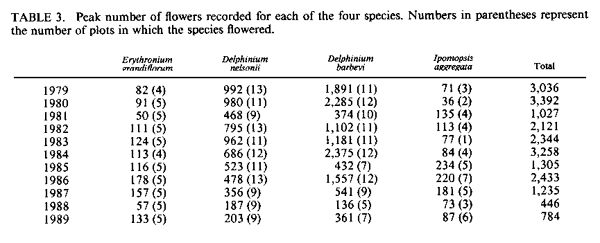
Data on flower abundance were collected from 29 2 x 2-m plots, located within 500-1,000 m of banding sites. Approximately every other day for most of the growing season (early May to mid-September), all flowers in the plots were counted. Plots were scattered among habitats including a dry rocky meadow (7 plots), aspen forest (2 plots), wet meadow (9 plots), dry (but not rocky) meadow (3 plots), aspen-meadow interface (3 plots) and willow-meadow interface (S plots). For each species in every plot, the peak number of flowers produced during a given year was determined. For analyses in this study, the peak numbers for each species were added across plots for each year to produce a single value of peak number of flowers. Not all species occurred in all plots; for example, Ipomopsis was only found in 1-7 of the plots in any given year. However, representation of species in the plots approximated their abundance at the study site.
Data from four species of flowers that are among those most commonly visited by hummingbirds at the study site were used for this analysis. They were Erythronium grandiflorum (glacier lily; Liliaceae), Delphinium nelsonii (Nelson's larkspur; Ranunculaceae), Delphinium barbeyi (tall larkspur; Ranunculaceae), and Ipomopsis aggregata (scarlet gilia; Polemoniaceae). Only the latter fits the classical characterization of a hummingbird-pollinated plant (long, red, tubular flowers). Data were not included for other flowers used by hummingbirds, such as Castilleja spp. (Scrophulariaceae), or Aquilegia elegantula (Ranunculaceae) because they were relatively rare.
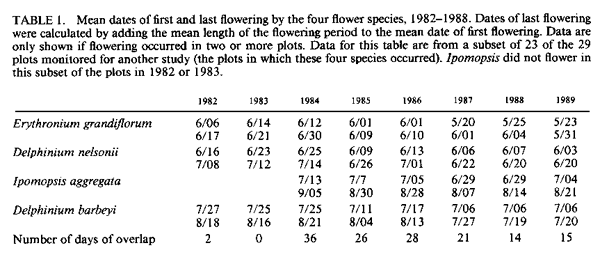
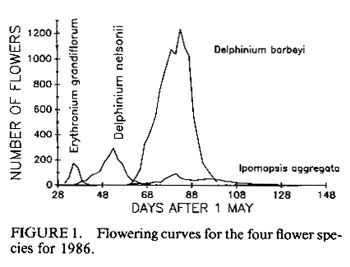
The four flower species used for this study span much of the flowering season (Table l; Fig. 1). Erythronium, with large, yellow, pendant lily flowers, is one of the first species to flower at the study site, and is also visited by bumblebees and other bees. The two blue-flowered Delphinium species are also visited frequently by bumblebees, while hummingbirds are the primary visitors to Ipomopsis (Waser 1982), although bumblebees commonly rob the nectar of Ipomopsis flowers in some years (Inouye 1980). Despite the variation among years in date of first flowering (Table 1), the relative sequence of flowering is generally maintained, and the arrival and nesting of the birds appear to be synchronized with flowering.
Results
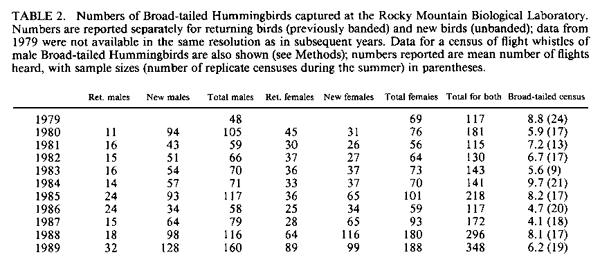
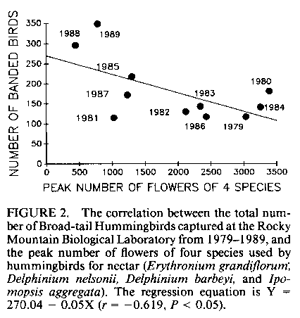
Table 2 summarizes the numbers of Broad-tailed Hummingbirds captured at RMBL from 19791989. The sex ratio among captures was biased in favor of males in 1980 and females in 1979 and 1988 (binomial probability test, P < 0.05). The total number of birds captured ranged from a low of 115 in 1981 to a high of 348 in 1989. From 1980-1987 the number of recaptured (probably resident) birds was more constant than the number of newly captured (probably migrant) birds. The number of birds captured was highest in 1988 and 1989, when the numbers of flowers were lower than in any other year. These were the only two consecutive years of low flower numbers during the study, and this sequence was apparently responsible for the large numbers of new birds (214) banded in 1988, and birds recaptured in 1989; many of the recaptures were first banded in 1988. There was also a large number of new hummingbirds in 1985.Data from the census of wing-whistle noises are also shown in Table 2; there was no significant correlation between these census data and the numbers of banded males (r < 0.100, n = 11, P > 0.05), or between the number of flowers and the number of males heard in the census of flight noises (r = 0.142, P > 0.05).
There was much variation among years in the number of flowers produced by each of the four plant species (Table 3). The reasons for this are not completely understood, although two factors appear to be important. First, there is a significant correlation between the number of flowers of both Delphinium species produced each summer and the amount of snowfall the previous winter (Inouye 1989); there is no such correlation for the other two species. Second, every four to five years (1976, 1981, 1985, 1989) since 1973 (when flower data were first collected from these plots) there have been late (mid-June) hard frosts (sometimes accompanied by snow) that have killed flower buds of many species (Inouye 1988). These two environmental events appear to be responsible for much of the annual variation in flower number in Delphinium species and for some of the other species in these meadows.
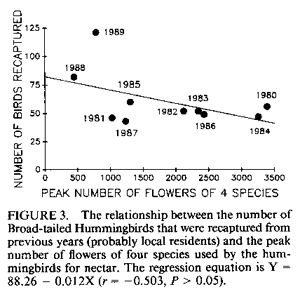
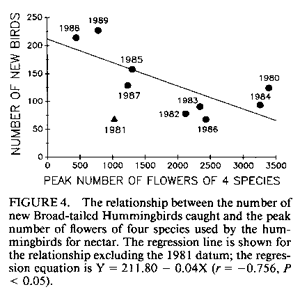
There is a significant negative correlation between the number of birds captured and the peak number of flowers (Fig. 2; r = -0.619, P < 0.05) for the period 1979-1989. If the capture data are broken down into numbers of recaptured birds and new birds (Table 2; data only available since 1980) and then correlated with flower numbers, the negative correlation for recaptured birds is not significant (Fig. 3; r = -0.503, 0.1 > P > 0.05), while the correlation for new birds is significant only if the 1981 datum is excluded (Fig. 4; r = -0.756, P < 0.05).
The year with the greatest deviation from the regression in Figure 4 is 1981, with fewer birds captured than predicted by the regression equation (and the lowest number of birds during the I l-year study). This year was also unusual in another regard: it was the only year in the past 15 years in which there was legitimate (not nectar robbing) visitation by large numbers of bumblebee queens (Bombus appositus) to Ipomopsis flowers (personal observations; Pleasants and Waser 1985). During 1981 the standing crop nectar volumes in Ipomopsis flowers were much higher than in all but one year ( 1977) of the seven in which they were measured from 1975-1984 (Pleasants and Waser 19 8 5). This apparently permitted bumblebee queens (which cannot normally reach it) to collect the nectar. There was also an unusual asynchrony between the time of peak flowering and the influx of Selasphorus rufus that year (Pleasants and Waser 1985). Together, these observations suggest that there was something unusual about the hummingbird populations at our study site in 1981. It appears that although the number of birds recaptured in 1981 was about that predicted by the regression equation (Fig. 3), the number of new birds was substantially lower than expected (Fig. 4).
Discussion
It is perhaps surprising that we found any significant relationship between flowers and bird abundance, given our crude index; only about 38% of the variation in numbers of banded birds is explained by variation in the four species of flowers. Although the flowers we used are significant resources for the birds, they are not the only species of flowers used by the birds, and they do vary in both temporal availability (Table 1) and in nectar production. The deviations from the regression lines may reflect fluctuations in background population levels of the birds, or in the reliability of our estimates of the floral environment from the hummingbird's point of view. As with any result based solely on correlation, and not explored further with experimental studies, we can suggest causative factors but cannot be positive about the definitive interpretation.Another factor that may cloud the correlation between numbers of birds and flowers is the fact that these birds are long-lived but are not resident at the study site year round; they only spend about two to three months of the year there. The rest of the year is spent in migration, or overwintering farther south (probably in southern Mexico). Thus the availability of food resources during the short breeding season may not be the most important factor regulating population size, even though it may affect the numbers of birds using feeders. Floral resources are also not the only food resources used by the hummingbirds. Insects provide a major source of protein as well as replacement of ions that are lost in the urine (Calder and Hiebert 1983).
Hummingbird populations may in fact be more constant than indicated by our data. This would be true if the explanation for increased numbers of banded birds is that during years with lower floral abundance, our population of banded birds derives from a larger area. During these years, for example, some birds probably fly farther to the feeders that we use to attract them for banding, and there might not actually be any significant variation in resident population size; we may just be increasing the size of our effective study area by drawing in more distant birds. The fact that the correlation between recaptured birds and number of flowers is not significant (i.e., numbers of recaptured birds are relatively invariant, with the exception of 1988-1989, when flower numbers were very low; Fig. 3), while that between new birds and number of flowers is significant (without the 1981 datum; Fig. 4), supports the hypothesis that there is a core population of resident birds and a variable number of birds from outlying areas that are drawn to feeders during years of low flower abundance.
There is circumstantial evidence to support this hypothesis of a relatively constant core population. For example, the numbers of birds using feeders varies seasonally. Use of feeders is highest during the early part of the season, when flowers are not yet available, and decreases as the availability of floral resources increases. At the end of the season, when floral abundance begins to decline, or when flowers are preempted by the more aggressive migrant Rufous Hummingbirds, use of feeders again increases. At times like this individual birds will fly 2-6 km to our feeders (W. Calder, unpubl. data).
The negative correlation between numbers of flowers and banded hummingbirds indicates one difficulty with use of artificial feeders to attract birds for population studies: there is potential for competition from natural food sources. In years with higher floral abundance, numbers of banded birds are lower, apparently reflecting decreased use of the feeders by birds with nests or territories at greater distances. Thus, despite a significant effort at capturing and banding birds each year, our results are biased by flower availability.
This pattern differs from that observed for nectarivorous honeyeaters by Pyke (1988); he found that despite a consistent seasonal pattern of daily production of nectar-energy per unit area, the seasonal pattern of honeyeater abundance was not consistent between years, and did not correspond to the pattern of nectar-energy production. He concluded that honeyeater abundances must be determined by factors other than local nectar production. However, Baltosser (1989) found that nectar availability was important to the organization of a guild of hummingbirds, and that they responded to reductions in nectar supplies. He also noted an effect of an unusual freeze on the distribution and number of hummingbird nests in one year. In this case, however, the effect was apparently mediated by damage to potential nest sites rather than floral resources.
Despite the variation we have seen in numbers of birds, there does not appear to be any particular long-term trend in either numbers of birds or of flowers at our study site, indicating that these populations may be at some type of equilibrium. The pattern we describe also suggests that there has been no negative effect of the banding study on the hummingbird population (contrary to fears raised by Rosenberg and Stejskal 1988 about the effect of banding). It does, however, suggest that banders who rely on resources such as feeders to attract birds for banding should be aware of the interactions between natural food supplies and feeders.
Departments of Zoology and Botany, University of Maryland, College Park, MD 20742
Department of Ecology and Evolutionary Biology, University of Arizona, Tucson, AZ 85721
Department of Biology, University of California, Riverside, CA 92521
How to choose Hummingbird nectar feeders ( Homemade hummingbird nectar )
For many years, homemade hummingbird nectar feeders were made by hand, often from bits and pieces of laboratory apparatus such as glass tubing, rubber stoppers, and reagent bottles or flasks. In recent years, however, interest in feeding hummingbirds has grown tremendously, and manufacturers have responded by designing and marketing many kinds of homemade hummingbird nectar feeders.
Commercially made homemade hummingbird nectar feeders come in all shapes and sizes. Since the plastic on this feeder is red, there's no reason to add food coloring to the sugar water. There is no conclusive scientific evidence red food coloring hurts hummingbirds, but since nearly every commercial feeder has at least some red on it already, the chemical additive isn't necessary. Better to attach a red ribbon to the feeder.
The best commercial homemade hummingbird nectar feeders are study, easy to clean and hang, and with a minimum number of parts that can get lost or broken. Manufacturers offer feeders in a variety of sizes with both plastic and glass reservoirs. Glass is long-lasting and can be sterilized easily, but it is heavier and can shatter when dropped; feeders with plastic reservoirs are less expensive but tend to discolor with age. Small feeders may have just one feeding port while larger ones have three or more. And many feeder types are available with or without perches on which hummingbirds can rest while feeding.
The biggest mistake made by most novice homemade hummingbird nectar enthusiasts is in buying a first feeder that is too large. It is better to start with a smaller feeder--perhaps with an 8oz (236.6ml) reservoir--rather than the one-quart (.95L) size that many people select. Filling the larger feeder and putting it out before hummingbirds arrive will usually result in the homemade hummingbird nectar souring long before the feeder can be drained by birds.
Lastly, put the homemade hummingbird nectar feeders in places where they can easily be seen by human observers for education and entertainment. After all, the homemade hummingbird nectar we provide is just a little bonus for the birds, which in nearly all cases can get along very well without us by using natural food sources.
Commercially made homemade hummingbird nectar feeders come in all shapes and sizes. Since the plastic on this feeder is red, there's no reason to add food coloring to the sugar water. There is no conclusive scientific evidence red food coloring hurts hummingbirds, but since nearly every commercial feeder has at least some red on it already, the chemical additive isn't necessary. Better to attach a red ribbon to the feeder.
The best commercial homemade hummingbird nectar feeders are study, easy to clean and hang, and with a minimum number of parts that can get lost or broken. Manufacturers offer feeders in a variety of sizes with both plastic and glass reservoirs. Glass is long-lasting and can be sterilized easily, but it is heavier and can shatter when dropped; feeders with plastic reservoirs are less expensive but tend to discolor with age. Small feeders may have just one feeding port while larger ones have three or more. And many feeder types are available with or without perches on which hummingbirds can rest while feeding.
The biggest mistake made by most novice homemade hummingbird nectar enthusiasts is in buying a first feeder that is too large. It is better to start with a smaller feeder--perhaps with an 8oz (236.6ml) reservoir--rather than the one-quart (.95L) size that many people select. Filling the larger feeder and putting it out before hummingbirds arrive will usually result in the homemade hummingbird nectar souring long before the feeder can be drained by birds.
Lastly, put the homemade hummingbird nectar feeders in places where they can easily be seen by human observers for education and entertainment. After all, the homemade hummingbird nectar we provide is just a little bonus for the birds, which in nearly all cases can get along very well without us by using natural food sources.
Researchers discover hummingbird secret (homemade hummingbird nectar)
Homemade hummingbird nectar blog:
"This was a very exciting moment for us," said Dr. Doug Wong-Wylie, Canada Research Chair in Behavioural and Systems Neuroscience and psychology professor at the U of A. "As soon as we looked at these specimens it was obvious that something was different in the hummingbirds' brains than other species."
Wong-Wylie and Dr. Andrew Iwaniuk, also from the Department of Psychology in the Faculty of Science, compared hummingbird brains to 28 other bird species, obtained from the National Museum of Natural History, the Field Museum of Natural History, and the Louisiana State University Museum of Natural Science. Hummingbirds are well known for their wing speed and ability to hover and fly forward and backward with more precision than a helicopter. It is critical that the hummingbird remain perfectly still as it feeds itself while darting in and out of flower blossoms with pinpoint accuracy. The bird must be able to maintain a stable position space, despite the fact that their wings are beating 75 times per second and that disruptive effects such as wind gusts could throw them off.
Much work has been done on the hummingbirds' physiological make up—such as its enlarged heart, high metabolic rate and specialized wing kinematics--but nothing has been done on the neural specializations of the bird.
"Part of the reason this type of work hasn't been done before is because of access to the birds," said Iwaniuk. "In Canada especially they tend to be uncommon, they come from exotic locales and they are not easy to catch, so we were very fortunate to be able to study the specimens we did."
The scientists found that a specific nuclei—one that detects any movement of the entire visual world—was two to five times bigger in the hummingbird than in any other species, relative to brain size. The hummingbird's brain is smaller than a fingertip. "We reasoned that this nucleus helps the hummingbird stay stationary in space, even while they're flying," said Wong-Wylie. "These birds must have a good optomotor response considering they are stationary 90 per cent of the time. This specific nuclei is likely responsible for that."
Wong-Wylie and Iwaniuk plan to continue this line of research and have hummingbirds track visual motion while watching the nucleus to see how it reacts.
Cheers up your hummingbird with homemade hummingbird nectar
Source: University of Alberta
"This was a very exciting moment for us," said Dr. Doug Wong-Wylie, Canada Research Chair in Behavioural and Systems Neuroscience and psychology professor at the U of A. "As soon as we looked at these specimens it was obvious that something was different in the hummingbirds' brains than other species."
Wong-Wylie and Dr. Andrew Iwaniuk, also from the Department of Psychology in the Faculty of Science, compared hummingbird brains to 28 other bird species, obtained from the National Museum of Natural History, the Field Museum of Natural History, and the Louisiana State University Museum of Natural Science. Hummingbirds are well known for their wing speed and ability to hover and fly forward and backward with more precision than a helicopter. It is critical that the hummingbird remain perfectly still as it feeds itself while darting in and out of flower blossoms with pinpoint accuracy. The bird must be able to maintain a stable position space, despite the fact that their wings are beating 75 times per second and that disruptive effects such as wind gusts could throw them off.
Much work has been done on the hummingbirds' physiological make up—such as its enlarged heart, high metabolic rate and specialized wing kinematics--but nothing has been done on the neural specializations of the bird.
"Part of the reason this type of work hasn't been done before is because of access to the birds," said Iwaniuk. "In Canada especially they tend to be uncommon, they come from exotic locales and they are not easy to catch, so we were very fortunate to be able to study the specimens we did."
The scientists found that a specific nuclei—one that detects any movement of the entire visual world—was two to five times bigger in the hummingbird than in any other species, relative to brain size. The hummingbird's brain is smaller than a fingertip. "We reasoned that this nucleus helps the hummingbird stay stationary in space, even while they're flying," said Wong-Wylie. "These birds must have a good optomotor response considering they are stationary 90 per cent of the time. This specific nuclei is likely responsible for that."
Wong-Wylie and Iwaniuk plan to continue this line of research and have hummingbirds track visual motion while watching the nucleus to see how it reacts.
Cheers up your hummingbird with homemade hummingbird nectar
Source: University of Alberta
How to make Homemade hummingbird nectar recipe
Homemade Hummingbird Nectar blog will show you how to make homemade hummingbird nectar.If you have a great feeder but the birds don't seem to be visiting. It could be your homemade hummingbird nectar. Hummingbird can be pretty picky when it comes to their favorite sauce.
If this situation was happen. You are no need to buy the powdered Hummingbird Nectar mix from the store for this attract hummingbirds. Although powdered hummingbird nectar mix is widely available at garden and home centers, it is quite easy and inexpensive to produce homemade hummingbird nectar by yourself and your homemade hummingbird nectar also can attract so many hummingbirds.I am going to show you how to make homemade hummingbird nectar that is easy and affordable and will keep hummingbirds returning to your feeders day by day and year by year.
Use the following :
1 part regular white sugar to 4 parts water.
1. Boil the water.
2. Add sugar and stir until dissolved.
3. Let cool.
4. Refrigerate in a designated hummingbird feeder pitcher.
Your hummingbirds will enjoy with this homemade hummingbird nectar.
If this situation was happen. You are no need to buy the powdered Hummingbird Nectar mix from the store for this attract hummingbirds. Although powdered hummingbird nectar mix is widely available at garden and home centers, it is quite easy and inexpensive to produce homemade hummingbird nectar by yourself and your homemade hummingbird nectar also can attract so many hummingbirds.I am going to show you how to make homemade hummingbird nectar that is easy and affordable and will keep hummingbirds returning to your feeders day by day and year by year.
Use the following :
1 part regular white sugar to 4 parts water.
1. Boil the water.
2. Add sugar and stir until dissolved.
3. Let cool.
4. Refrigerate in a designated hummingbird feeder pitcher.
Your hummingbirds will enjoy with this homemade hummingbird nectar.
Bird Feeders Children Can Make ( homemade hummingbird nectar)
Bird Feeders Children Can Make
homemade hummingbird nectar
Birdwatching is fun for kids of all ages, can be done in your own back yard, and doesn’t cost a cent.
Borrow a birdwatching guide from the public library and see how many different types of birds your kids can find.
How to attract birds to your back yard? Feed them, of course! The easiest bird feeder is to simply spread suet onto a tree just above where a small branch juts out. Birds will perch on the branch and enjoy the suet.
You can build a simple bird feeder out of recycled household materials, for a fun spring craft for you and your children to work on together.
Here are some ideas for homemade bird feeders:
homemade hummingbird nectar
Birdwatching is fun for kids of all ages, can be done in your own back yard, and doesn’t cost a cent.
Borrow a birdwatching guide from the public library and see how many different types of birds your kids can find.
How to attract birds to your back yard? Feed them, of course! The easiest bird feeder is to simply spread suet onto a tree just above where a small branch juts out. Birds will perch on the branch and enjoy the suet.
You can build a simple bird feeder out of recycled household materials, for a fun spring craft for you and your children to work on together.
Here are some ideas for homemade bird feeders:
Orange Bird Feeder
Cut the top off of an orange and scoop out the insides, leaving the white pith as a lining. Using a pencil, pen or screwdriver, poke three or four holes near the top open end, equidistant from one another, and thread through separate pieces of string. Gather the strings together in the center and tie them together. Fill the orange with bird seed. Tie another length of string around the knot of strings and loop it around a branch.
Cut the top off of an orange and scoop out the insides, leaving the white pith as a lining. Using a pencil, pen or screwdriver, poke three or four holes near the top open end, equidistant from one another, and thread through separate pieces of string. Gather the strings together in the center and tie them together. Fill the orange with bird seed. Tie another length of string around the knot of strings and loop it around a branch.
Coconut Shell Bird Feeder
Similar to the orange bird feeder, use a coconut shell half with the flesh scooped out, drill holes near the top and thread through string. Hang from a branch and fill the coconut shell with seeds and berries.
Homemade Hummingbird Feeder
Hummingbirds live on a diet of insects and spiders, but need sugary nectar for energy. Providing nectar will attract the most hummingbirds to your back yard. Children can make a hummingbird feeder from a glass soft drink bottle and a coat hanger, with a little bit of help from a parent.
With wire cutters, cut the hook-and-twisted-neck part off of a coat hanger. Bend the remaining part of the coat hanger around a 16- or 20-ounce soft drink bottle, at an angle. Bend a hook into the wire on the bottom end to hang the feeder from a tree branch. Bend the other end of the wire, near the mouth of the bottle, to form a perch for the hummingbird. Make a hole in the bottle cap by pressing a 1/8-inch drill bit into the center of the cap and twisting the bottle, applying pressure until a hole is made.
Now fill the bottle ½ full with nectar, place the cap on the bottle and hang face down at an angle so that the nectar settles near the opening, where a hummingbird can feed.
Hummingbirds are attracted to the color red, so decorate your homemade hummingbird feeder with red crepe paper, or paint designs on the bottle with red paint. Don’t add red food coloring to your nectar, because it may be harmful to birds.
To make hummingbird nectar, mix one part sugar and four parts water and stir to dissolve. You can store unused syrup in the refrigerator for up to two weeks.
Similar to the orange bird feeder, use a coconut shell half with the flesh scooped out, drill holes near the top and thread through string. Hang from a branch and fill the coconut shell with seeds and berries.
Homemade Hummingbird Feeder
Hummingbirds live on a diet of insects and spiders, but need sugary nectar for energy. Providing nectar will attract the most hummingbirds to your back yard. Children can make a hummingbird feeder from a glass soft drink bottle and a coat hanger, with a little bit of help from a parent.
With wire cutters, cut the hook-and-twisted-neck part off of a coat hanger. Bend the remaining part of the coat hanger around a 16- or 20-ounce soft drink bottle, at an angle. Bend a hook into the wire on the bottom end to hang the feeder from a tree branch. Bend the other end of the wire, near the mouth of the bottle, to form a perch for the hummingbird. Make a hole in the bottle cap by pressing a 1/8-inch drill bit into the center of the cap and twisting the bottle, applying pressure until a hole is made.
Now fill the bottle ½ full with nectar, place the cap on the bottle and hang face down at an angle so that the nectar settles near the opening, where a hummingbird can feed.
Hummingbirds are attracted to the color red, so decorate your homemade hummingbird feeder with red crepe paper, or paint designs on the bottle with red paint. Don’t add red food coloring to your nectar, because it may be harmful to birds.
To make hummingbird nectar, mix one part sugar and four parts water and stir to dissolve. You can store unused syrup in the refrigerator for up to two weeks.
Pinecone Bird Feeder
A pinecone bird feeder is an all-natural addition to a backyard tree. Tie a string to the top of a pinecone. Spread peanut butter all over a pinecone and roll it onto a pile of birdseed. Hang from a tree branch.
Toilet Paper Roll Bird Feeder
Poke holes in the top of a toilet paper roll and thread string through. Brush honey or peanut butter onto the roll using a paintbrush or plastic knife. Roll in birdseed and hang on a tree branch.
A pinecone bird feeder is an all-natural addition to a backyard tree. Tie a string to the top of a pinecone. Spread peanut butter all over a pinecone and roll it onto a pile of birdseed. Hang from a tree branch.
Toilet Paper Roll Bird Feeder
Poke holes in the top of a toilet paper roll and thread string through. Brush honey or peanut butter onto the roll using a paintbrush or plastic knife. Roll in birdseed and hang on a tree branch.
Making a hummingbird garden
Providing nectar feeders is the quickest and simplest way to attract hummingbirds to your backyard.However, planting nectar bearing flowers is the best long term approach to keeping them around. Get started now with your own hummingbird garden and watch it grow year by year!
Flowers and Foliage That Attract Hummingbirds
Flowers and Foliage That Attract Hummingbirds
- Flowers that depend on the hummingbird for pollination, do all they can to please and attract Hummingbirds. Their blossoms project into the open where the birds won’t get caught in the foliage. Their trumpet shapes accommodate their long bills, and discourage other insects. Since Hummingbirds have no ability to smell, the flowers do not need to be scented. Red, tube like flowers are your best choice to attract Hummingbirds. A good term to become familiar with is "ornithophilous" which describes a bird-loving plant.
- Talk to the experts at your local garden center to select plants that grow best in your area. Your first choice should be flowers and plants that grow naturally in your region.
- Select flowers that bloom at different times of the year. You don't want your garden to bloom all at once.
- Try not to use pesticides in your hummingbird garden. Hummingbirds will enjoy eating the spiders, aphids and gnats as an added source of protein.
- Create both sun and shade area in your hummingbird garden. A good hummingbird garden has more than just hummingbird flowers. It is a whole habitat. Sun and shade should be created by trees and open areas. Your hummingbird flowers will need sun to grow and your hummingbirds will need the shade to perch in between feedings.
- Don't forget the importance of plants that provide nesting materials. Hummingbirds like downy like materials for their nests, using these fibers with bits of leaves, spider webs, moss, and lichens to construct their nests. Willow trees and eucalyptus trees are invaluable for providing downy like materials.
- Hummingbirds love to bathe on misted leaves. Add a water mister around broad leafed plants and watch them take a bath!
- Be sure to position your hummingbird garden where you can see it and get the most enjoyment out of it.
hummingbird migration - ruby-throated (homemade hummingbird nectar)
Hummingbird migration - ruby-throated
homemade hummingbird nectar
Migration of the ruby-throated hummingbird has been an inspiration and a wonder and a scientific puzzle for years. Shrimp fishermen and workmen on oil rigs reported that they found ruby-throated hummingbirds far out in the Gulf of Mexico (100 and 200 miles) where they did not belong. There were sightings along the coast of hummingbirds skimming fast over the water onto shore – annually – in step with migration cycles. Where did they come from?
Now we know that one of the common migration pathways of the ruby-throated hummingbird directly crosses the Gulf of Mexico. They fly across the water and travel north to breed – as far as Canada – and then south again to reach their winter homes in Mexico and Central America.8
The idea that a hummingbird could or would! fly across a minimum! 457 miles of water was dismissed as illogical and impossible. Hummingbirds have to eat and drink constantly – there would be no food or rest. Hummingbirds could not fly against winds – a headwind of only 20 miles per hour brings them to a complete stop.2 Yet the consistency of amateur sightings caused the scientific community to look for the improbable and they found it.
Migrating hummingbirds are fat! Just before they answer the call to travel north or south, they eat in excess and build a layer of rich fatty fuel just under their skin – along the back and belly and throat. A hummingbird will gain 25 – 40% extra body-weight in fat8 and that is enough weight to keep larger birds on the ground. The smaller the bird, the higher the proportion of body fat it can carry and still fly.2 Add the strength and efficient flight of a hummingbird and you are ready for a probable journey of 22 non-stop hours across the Gulf of Mexico.10
It is dangerous. A ruby-throated hummingbird that started out weighing 1/10th of one ounce might gain .07 ounces of fat and therefore have enough fuel to travel 1,400 miles – with no wind of any kind. A headwind of only 10 miles per hour will cut that distance down to 600 miles and more than 20 mph will push them backward.2 They can be blown sideways – Gulf winds are unpredictable.
It is bold because there is no guarantee that reaching land means reaching food. There may be no flowers in bloom and the migrating hummingbirds will have to search for nectar when they are exhausted.
The Gulf of Mexico is not the only barrier that imposes this migrational fasting. A researcher reported that a Rufous hummingbird fell out of the sky over the Mojave Desert – the bird did not make the crossing safely. It is reported that ½ to ¾ of the newborn ruby-throated hummingbirds do not survive their first year of migration.10
Migrating birds of all kinds have adapted to the weather and wait for favorable winds. The ruby-throated hummingbird takes advantage of tail winds constantly. Research in the Appalachian Mountains of Pennsylvania showed that migrating hummingbirds appeared in greater numbers when the winds blew favorably and even more when the winds were stronger.
Another study of ruby-throated hummingbirds has reported that when they gain 2 grams of fat, they have enough fuel to cross 600 miles of water without tailwinds.8 So they eat in excess and wait for cold fronts to carry them on their way.
The Eastern United States is host to the ruby-throated hummingbird for much of the spring and summer every year. They usually travel north and south along the Appalachian Mountains and the earliest birds to come in the spring seem to follow available insect populations rather than flowers.
Ruby-throated hummingbirds have an urgent drive to reach their breeding grounds and sometimes arrive before the flowers bloom - surviving on insects and sugar water provided by kindly humans.2 They will only stay in one place, during migration, for an average of 7 – 14 days. The first arrivals in spring are usually male and they may be seen as much as three weeks before the others. It can be that this protects the females and young because they follow the bright plumage of the male and find a ready food supply. If a northbound male hummingbird finds an ample supply of flowers and nectar he may be enticed to stay and establish a territory and therefore attract females and competition from other males. This is the principle behind hanging your hummingbird feeders strategically to “capture” their attention.
The East Coast range of the ruby-throated hummingbird broadens out as far as all the deciduous forests. The forests are rich in flowers and insects and provide an unusual source of food for this bird – tree sap. The farthest north that the ruby-throated and Rufous hummingbirds will range is directly related to the Yellow-bellied Sap Sucker.8 The Sap Sucker bores holes through the tree bark and the sap that weeps out of the “wells” provide food for both of these hummingbirds. Tree sap is similar in nutrition to natural or homemade hummingbird nectar
In the fall there is an instinctual clock that tells the hummingbirds when to head south. People still disagree over the precise mechanism within the bird that causes this. Most sources say that every expert agrees that food supply is not a factor and there is no reason to take down hummingbird feeders to stimulate migration.
Most experts believe that migration in hummingbirds is stimulated by changes in sunlight but hummers do not seem to have the same biological components that cause this in other migrating birds – hence the lack of proof.
Then we have an expert biologist from Canada who says that in the northernmost climates, he has seen hummingbirds stay too long because of feeders and become out-of-sync with the supplies of food farther south.
Another expert in hummingbird banding says that only underweight birds stay at feeders – and they are already out-of-sync with their migration because they did not or could not fuel up soon enough. Birds that are born late in the season are vulnerable. The time it takes to migrate far north into Canada may put high numbers of Canadian birds at a weight disadvantage. Leaving your feeders up may provide a critical opportunity for these hummingbirds to build reserves and “catch up.”10 Our northern biologist would say - fatten up and then travel south into deprivation. Our banding expert would say, this is a bird who is already in trouble – not a problem created by feeders.
These are the ethical choices for feeding wild hummingbirds. My own conclusions are to take the feeders down in the far north and leave them up in the middle and southern states. I am content that this is illogical. Truthfully, we just don't know enough and more recent research in science publications may shed new light on the subject .
As the ruby-throated hummingbird migrates southward, it averages about 23 miles per day.8 This sounds like a lot but is actually somewhat leisurely and not extreme for the bird. They are used to accumulating many miles every day while feeding on nearly 2,000 flowers.
Southbound ruby-throats rebuild their reserves in the early morning, travel midday and forage again in the late afternoon to keep up their body weight. There is a convenient refueling system provided by flowering spotted jewelweed. It consistently blossoms a few days ahead of the migration – providing abundant nectar for the hummingbirds. There is thoughtful speculation that the blossoming of jewelweed is an integral part of the timing that paces the hummingbirds as they travel south. Without jewelweed, there would not be enough to eat. A bird that misses the “wave” of flowers opening southward, may not survive.8
Not every ruby-throated hummingbird crosses the Gulf of Mexico to get “home”. There are three other common routes. Many come down from Canada on a western route through Texas and cross into Mexico directly. Others reach the coast and turn west - traveling around the Gulf so they do not have to make the water crossing. Still others circle east and hop through the Caribbean Islands into Cuba so their journey across the ocean is not so long.8
It has been reported that hummingbirds that do fly across the sea will wait for favorable winds and then climb high out of sight – as much as 200 feet - for their southern journey. When they come north, they are often seen skimming close to the waves.2
Regardless of which migration route they take, hummingbirds will take the same path that was imprinted the first year that they flew. And they fly alone. Young hummingbirds do not follow their parents and they do not fly in flocks.10 You have to wonder what causes one to circle left and one to circle right and one to rise higher and higher and fly out over that nothingness of water. It is an inspiration and a wonder and remains a scientific puzzle.
homemade hummingbird nectar
Migration of the ruby-throated hummingbird has been an inspiration and a wonder and a scientific puzzle for years. Shrimp fishermen and workmen on oil rigs reported that they found ruby-throated hummingbirds far out in the Gulf of Mexico (100 and 200 miles) where they did not belong. There were sightings along the coast of hummingbirds skimming fast over the water onto shore – annually – in step with migration cycles. Where did they come from?
Now we know that one of the common migration pathways of the ruby-throated hummingbird directly crosses the Gulf of Mexico. They fly across the water and travel north to breed – as far as Canada – and then south again to reach their winter homes in Mexico and Central America.8
The idea that a hummingbird could or would! fly across a minimum! 457 miles of water was dismissed as illogical and impossible. Hummingbirds have to eat and drink constantly – there would be no food or rest. Hummingbirds could not fly against winds – a headwind of only 20 miles per hour brings them to a complete stop.2 Yet the consistency of amateur sightings caused the scientific community to look for the improbable and they found it.
Migrating hummingbirds are fat! Just before they answer the call to travel north or south, they eat in excess and build a layer of rich fatty fuel just under their skin – along the back and belly and throat. A hummingbird will gain 25 – 40% extra body-weight in fat8 and that is enough weight to keep larger birds on the ground. The smaller the bird, the higher the proportion of body fat it can carry and still fly.2 Add the strength and efficient flight of a hummingbird and you are ready for a probable journey of 22 non-stop hours across the Gulf of Mexico.10
It is dangerous. A ruby-throated hummingbird that started out weighing 1/10th of one ounce might gain .07 ounces of fat and therefore have enough fuel to travel 1,400 miles – with no wind of any kind. A headwind of only 10 miles per hour will cut that distance down to 600 miles and more than 20 mph will push them backward.2 They can be blown sideways – Gulf winds are unpredictable.
It is bold because there is no guarantee that reaching land means reaching food. There may be no flowers in bloom and the migrating hummingbirds will have to search for nectar when they are exhausted.
The Gulf of Mexico is not the only barrier that imposes this migrational fasting. A researcher reported that a Rufous hummingbird fell out of the sky over the Mojave Desert – the bird did not make the crossing safely. It is reported that ½ to ¾ of the newborn ruby-throated hummingbirds do not survive their first year of migration.10
Migrating birds of all kinds have adapted to the weather and wait for favorable winds. The ruby-throated hummingbird takes advantage of tail winds constantly. Research in the Appalachian Mountains of Pennsylvania showed that migrating hummingbirds appeared in greater numbers when the winds blew favorably and even more when the winds were stronger.
Another study of ruby-throated hummingbirds has reported that when they gain 2 grams of fat, they have enough fuel to cross 600 miles of water without tailwinds.8 So they eat in excess and wait for cold fronts to carry them on their way.
The Eastern United States is host to the ruby-throated hummingbird for much of the spring and summer every year. They usually travel north and south along the Appalachian Mountains and the earliest birds to come in the spring seem to follow available insect populations rather than flowers.
Ruby-throated hummingbirds have an urgent drive to reach their breeding grounds and sometimes arrive before the flowers bloom - surviving on insects and sugar water provided by kindly humans.2 They will only stay in one place, during migration, for an average of 7 – 14 days. The first arrivals in spring are usually male and they may be seen as much as three weeks before the others. It can be that this protects the females and young because they follow the bright plumage of the male and find a ready food supply. If a northbound male hummingbird finds an ample supply of flowers and nectar he may be enticed to stay and establish a territory and therefore attract females and competition from other males. This is the principle behind hanging your hummingbird feeders strategically to “capture” their attention.
The East Coast range of the ruby-throated hummingbird broadens out as far as all the deciduous forests. The forests are rich in flowers and insects and provide an unusual source of food for this bird – tree sap. The farthest north that the ruby-throated and Rufous hummingbirds will range is directly related to the Yellow-bellied Sap Sucker.8 The Sap Sucker bores holes through the tree bark and the sap that weeps out of the “wells” provide food for both of these hummingbirds. Tree sap is similar in nutrition to natural or homemade hummingbird nectar
In the fall there is an instinctual clock that tells the hummingbirds when to head south. People still disagree over the precise mechanism within the bird that causes this. Most sources say that every expert agrees that food supply is not a factor and there is no reason to take down hummingbird feeders to stimulate migration.
Most experts believe that migration in hummingbirds is stimulated by changes in sunlight but hummers do not seem to have the same biological components that cause this in other migrating birds – hence the lack of proof.
Then we have an expert biologist from Canada who says that in the northernmost climates, he has seen hummingbirds stay too long because of feeders and become out-of-sync with the supplies of food farther south.
Another expert in hummingbird banding says that only underweight birds stay at feeders – and they are already out-of-sync with their migration because they did not or could not fuel up soon enough. Birds that are born late in the season are vulnerable. The time it takes to migrate far north into Canada may put high numbers of Canadian birds at a weight disadvantage. Leaving your feeders up may provide a critical opportunity for these hummingbirds to build reserves and “catch up.”10 Our northern biologist would say - fatten up and then travel south into deprivation. Our banding expert would say, this is a bird who is already in trouble – not a problem created by feeders.
These are the ethical choices for feeding wild hummingbirds. My own conclusions are to take the feeders down in the far north and leave them up in the middle and southern states. I am content that this is illogical. Truthfully, we just don't know enough and more recent research in science publications may shed new light on the subject .
As the ruby-throated hummingbird migrates southward, it averages about 23 miles per day.8 This sounds like a lot but is actually somewhat leisurely and not extreme for the bird. They are used to accumulating many miles every day while feeding on nearly 2,000 flowers.
Southbound ruby-throats rebuild their reserves in the early morning, travel midday and forage again in the late afternoon to keep up their body weight. There is a convenient refueling system provided by flowering spotted jewelweed. It consistently blossoms a few days ahead of the migration – providing abundant nectar for the hummingbirds. There is thoughtful speculation that the blossoming of jewelweed is an integral part of the timing that paces the hummingbirds as they travel south. Without jewelweed, there would not be enough to eat. A bird that misses the “wave” of flowers opening southward, may not survive.8
Not every ruby-throated hummingbird crosses the Gulf of Mexico to get “home”. There are three other common routes. Many come down from Canada on a western route through Texas and cross into Mexico directly. Others reach the coast and turn west - traveling around the Gulf so they do not have to make the water crossing. Still others circle east and hop through the Caribbean Islands into Cuba so their journey across the ocean is not so long.8
It has been reported that hummingbirds that do fly across the sea will wait for favorable winds and then climb high out of sight – as much as 200 feet - for their southern journey. When they come north, they are often seen skimming close to the waves.2
Regardless of which migration route they take, hummingbirds will take the same path that was imprinted the first year that they flew. And they fly alone. Young hummingbirds do not follow their parents and they do not fly in flocks.10 You have to wonder what causes one to circle left and one to circle right and one to rise higher and higher and fly out over that nothingness of water. It is an inspiration and a wonder and remains a scientific puzzle.
hummingbird traplining and foraging (homemade hummingbird nectar)
Hummingbird - traplining and foraging
Homemade hummingbird nectar
Hummingbirds have developed strategies and physical characteristics that guarantee exclusive food supplies. Their lives depend on it.
Some hummingbirds are “residents” and establish feeding territories which they will fight to defend. Some hummingbirds are “territorial” and will defend an area of rich flowers for as long as they are in bloom or until the migration instinct moves them along.
Other hummingbirds have developed curved long bills that guarantee that there is no competition for the nectar of the flowers they sample.12 The most fascinating hummingbird feeding methods are called traplining and peripheral foraging.
Traplining is a method of foraging where the hummingbird has a “flight plan” that wanders through the same few flowers over long distances. This kind of hummingbird has longer wings and hovers and flies more efficiently because it is not built for maneuvers needed to defend a territory.
Traplining hummingbirds fly faster between flowers that are farther apart. The seconds that are saved allow them to eat more food (gather more energy) than it took to fly fast.
Traplining has been known to save a hummingbird 35-40% in expended energy because food is gathered more efficiently and no energy is used to defend a territory.
There are some quaint variations among trapliners. Two hummingbirds, the green violet-ear and the stripe-tailed, are “realistic” about their food consumption. If it is too much work to defend a territory, then they will trapline, switching back and forth as opportunity presents.
Three species of hummingbirds allow each gender to eat however they like. The males of the purple-throated mountain gem, broadtailed hummingbirds and Anna's hummingbirds are often territorial and the females usually prefer traplining. Their wings are different within the species.2
Rufous hummingbirds defend their territory and practice “peripheral feeding.” Early in the morning, they fly out to the outer edge of their territory and feed on the flowers there first. It is a first-come-first-serve strategy that creates a kind of “fire break” of unappealing flowers. If the Rufous hummingbird did not do this, then “territory parasites” - hummers that steal nectar where they can could endanger the food supply and therefore the life of the hummingbird.12
Every strategy and adaptation allows the hummingbird to survive and flourish. Some reports would like to believe that hummingbird fights are mild training, fun and exercise. Perhaps in courtship but nothing the hummingbird does is wasted and so they remind us to tend and harvest our resources with fierce responsibility.
Homemade hummingbird nectar
Hummingbirds have developed strategies and physical characteristics that guarantee exclusive food supplies. Their lives depend on it.
Some hummingbirds are “residents” and establish feeding territories which they will fight to defend. Some hummingbirds are “territorial” and will defend an area of rich flowers for as long as they are in bloom or until the migration instinct moves them along.
Other hummingbirds have developed curved long bills that guarantee that there is no competition for the nectar of the flowers they sample.12 The most fascinating hummingbird feeding methods are called traplining and peripheral foraging.
Traplining is a method of foraging where the hummingbird has a “flight plan” that wanders through the same few flowers over long distances. This kind of hummingbird has longer wings and hovers and flies more efficiently because it is not built for maneuvers needed to defend a territory.
Traplining hummingbirds fly faster between flowers that are farther apart. The seconds that are saved allow them to eat more food (gather more energy) than it took to fly fast.
Traplining has been known to save a hummingbird 35-40% in expended energy because food is gathered more efficiently and no energy is used to defend a territory.
There are some quaint variations among trapliners. Two hummingbirds, the green violet-ear and the stripe-tailed, are “realistic” about their food consumption. If it is too much work to defend a territory, then they will trapline, switching back and forth as opportunity presents.
Three species of hummingbirds allow each gender to eat however they like. The males of the purple-throated mountain gem, broadtailed hummingbirds and Anna's hummingbirds are often territorial and the females usually prefer traplining. Their wings are different within the species.2
Rufous hummingbirds defend their territory and practice “peripheral feeding.” Early in the morning, they fly out to the outer edge of their territory and feed on the flowers there first. It is a first-come-first-serve strategy that creates a kind of “fire break” of unappealing flowers. If the Rufous hummingbird did not do this, then “territory parasites” - hummers that steal nectar where they can could endanger the food supply and therefore the life of the hummingbird.12
Every strategy and adaptation allows the hummingbird to survive and flourish. Some reports would like to believe that hummingbird fights are mild training, fun and exercise. Perhaps in courtship but nothing the hummingbird does is wasted and so they remind us to tend and harvest our resources with fierce responsibility.
Recycled Soda Bottle Bird Feeder (homemade hummingbird nectar)
Recycled Soda Bottle Bird Feeder
Homemade hummingbird nectar
CRAFT MATERIALS:
Clean 1-liter soda bottle
Craft knife
2 wooden spoons
small eye screw
Length of twine for hanging
1. Start by drawing a 1/2-inch asterisk on the side of a clean 1-liter soda bottle, about 4 inches from the bottom. Rotate the bottle 90 degrees and draw another asterisk 2 inches from the bottom. Draw a 1-inch-wide circle opposite each asterisk
2. Use a craft knife to slit the asterisk lines and cut out the circles (a parent's job). Insert a wooden spoon handle first through each hole and then through the opposite asterisk
3. Remove the bottle cap and twist a small eye screw into the top of it for hanging.
4. Finally, fill your homemade hummingbird nectar into feeder with birdseed, recap it, and use a length of twine to hang it from a tree.
Homemade hummingbird nectar
CRAFT MATERIALS:
Clean 1-liter soda bottle
Craft knife
2 wooden spoons
small eye screw
Length of twine for hanging
1. Start by drawing a 1/2-inch asterisk on the side of a clean 1-liter soda bottle, about 4 inches from the bottom. Rotate the bottle 90 degrees and draw another asterisk 2 inches from the bottom. Draw a 1-inch-wide circle opposite each asterisk
2. Use a craft knife to slit the asterisk lines and cut out the circles (a parent's job). Insert a wooden spoon handle first through each hole and then through the opposite asterisk
3. Remove the bottle cap and twist a small eye screw into the top of it for hanging.
4. Finally, fill your homemade hummingbird nectar into feeder with birdseed, recap it, and use a length of twine to hang it from a tree.
Homemade Hummingbird Feeder ( homemade hummingbird nectar)
How to Make a Hummingbird Feeder
Homemade hummingbird nectar
Here is all you need to make a hummingbird feeder.
Gatorade Bottle (or any other bottle you want to use as a container)
A Large Salad Dressing Bottle Cap (or any other bottle cap that is slightly larger and deeper than the Gatorade Bottle Cap)
Drill
A Napkin
Hot Glue Gun
Glue for the Hot Glue Gun.
Pliers (optional)
Aluminum Foil (optional)
Scissors (optional)
Non-Toxic Paint (optional)
Faux flowers (optional)
For these directions we will use an empty Gatorade Bottle as our tank and part of the base. We like the Gatorade bottles because the mouth of the bottle is large making it easier to clean with a Hummingbird Feeder Brush. It is also easy to change the tank out if the plastic yellow's in the sun and there are pre-made ridges in the bottle to wrap some string or wire around to hang the finished feeder up. You can make a hummingbird feeder with any old bottle that has a top you can modify and still screw it back on the bottle. Some suggestions, try an old soda bottle, a mason jar, or even an old water bottle.
Ok, let's get down to business. Take the top off of the Gatorade Bottle. We are going to completely rebuild this top to become the base of the hummingbird feeder.
Using your drill, carefully make a bunch of hole in the center of the top bottle cap. Still being very careful with the drill (and pliers if needed) work the holes through to make one big hole in the center of the bottle cap. Now, pick up the salad dressing jar. Keep the cap and throw away the jar. We are using the salad dressing jar cap because the cap is slightly larger and deeper than the Gatorade bottle cap.
Get the napkin and tear it in half. Push half the napkin through the center hole of the Gatorade bottle top, leaving a little sticking out. This is a temporary spacer to keep the Gatorade bottle top off the bottom of the salad dressing top while we glue them together. If we don't do this, the hummingbird nectar will not be able to flow into salad dressing top for them to drink. Place the Gatorade bottle cap with the napkin through the hole directly into the center of the salad dressing top.
Make sure the Gatorade bottle top is slightly below the rim of the Salad Dressing top like shown in the picture. You also want to try to keep the Gatorade bottle top as level as possible with the salad dressing top. Adjust the napkin as much as needed to get the spacing just right. Using the hot glue gun, build up four bridges that will glue the two lids together, keeping the Gatorade lid off the bottom of the salad dressing lid. By slowly building up the hot glue, the glue won't flow all over the bottom of the salad dressing lid. After the glue has completely dried, carefully take out the entire napkin. Inspect the two caps to make sure the Gatorade lid is floating off the bottom of the salad dressing jar. Also inspect the two caps to make sure the top of the Gatorade lid is below the rim of the salad dressing lid.
Take the Gatorade bottle and screw it onto your new bottle top. And you have the basics of a hummingbird feeder, without the flowers.
Now would be a good time to decorate your feeder. Remember to use red (and maybe yellow) as it is a hummingbird's favorite color. You can use silk or fabric flowers if you like when making your hummingbird feeder as long as the ink in the fabric does not run into the nectar when it gets wet. This would not be very good for the hummingbirds. Twine, string, rope, or wire can be used to create a mounting bracket for your homemade hummingbird feeder. If you need to drill and eye hook into the top of your hummingbird feeder to hang it up, make sure you re-seal the hole so that no air or water can leak.
Homemade hummingbird nectar
Here is all you need to make a hummingbird feeder.
Gatorade Bottle (or any other bottle you want to use as a container)
A Large Salad Dressing Bottle Cap (or any other bottle cap that is slightly larger and deeper than the Gatorade Bottle Cap)
Drill
A Napkin
Hot Glue Gun
Glue for the Hot Glue Gun.
Pliers (optional)
Aluminum Foil (optional)
Scissors (optional)
Non-Toxic Paint (optional)
Faux flowers (optional)
For these directions we will use an empty Gatorade Bottle as our tank and part of the base. We like the Gatorade bottles because the mouth of the bottle is large making it easier to clean with a Hummingbird Feeder Brush. It is also easy to change the tank out if the plastic yellow's in the sun and there are pre-made ridges in the bottle to wrap some string or wire around to hang the finished feeder up. You can make a hummingbird feeder with any old bottle that has a top you can modify and still screw it back on the bottle. Some suggestions, try an old soda bottle, a mason jar, or even an old water bottle.
Ok, let's get down to business. Take the top off of the Gatorade Bottle. We are going to completely rebuild this top to become the base of the hummingbird feeder.
Using your drill, carefully make a bunch of hole in the center of the top bottle cap. Still being very careful with the drill (and pliers if needed) work the holes through to make one big hole in the center of the bottle cap. Now, pick up the salad dressing jar. Keep the cap and throw away the jar. We are using the salad dressing jar cap because the cap is slightly larger and deeper than the Gatorade bottle cap.
Get the napkin and tear it in half. Push half the napkin through the center hole of the Gatorade bottle top, leaving a little sticking out. This is a temporary spacer to keep the Gatorade bottle top off the bottom of the salad dressing top while we glue them together. If we don't do this, the hummingbird nectar will not be able to flow into salad dressing top for them to drink. Place the Gatorade bottle cap with the napkin through the hole directly into the center of the salad dressing top.
Make sure the Gatorade bottle top is slightly below the rim of the Salad Dressing top like shown in the picture. You also want to try to keep the Gatorade bottle top as level as possible with the salad dressing top. Adjust the napkin as much as needed to get the spacing just right. Using the hot glue gun, build up four bridges that will glue the two lids together, keeping the Gatorade lid off the bottom of the salad dressing lid. By slowly building up the hot glue, the glue won't flow all over the bottom of the salad dressing lid. After the glue has completely dried, carefully take out the entire napkin. Inspect the two caps to make sure the Gatorade lid is floating off the bottom of the salad dressing jar. Also inspect the two caps to make sure the top of the Gatorade lid is below the rim of the salad dressing lid.
Take the Gatorade bottle and screw it onto your new bottle top. And you have the basics of a hummingbird feeder, without the flowers.
Now would be a good time to decorate your feeder. Remember to use red (and maybe yellow) as it is a hummingbird's favorite color. You can use silk or fabric flowers if you like when making your hummingbird feeder as long as the ink in the fabric does not run into the nectar when it gets wet. This would not be very good for the hummingbirds. Twine, string, rope, or wire can be used to create a mounting bracket for your homemade hummingbird feeder. If you need to drill and eye hook into the top of your hummingbird feeder to hang it up, make sure you re-seal the hole so that no air or water can leak.
Natural hummingbird diet (homemade hummingbird nectar)
Natural hummingbird diet
Homemade hummingbird nectar
Hummingbirds feed on the natural or homemade hummingbird nectar and are important pollinators, especially of deep-throated, tubular flowers. Like bees, they are able to assess the amount of sugar in the natural or homemade hummingbird nectar they eat; they reject flower types that produce nectar which is less than 10% sugar and prefer those whose sugar content is stronger. Natural or homemade hummingbird nectar is a poor source of nutrients, so hummingbirds meet their needs for protein, amino acids, vitamins, minerals, etc. by preying on insects and spiders, especially when feeding young.
Most hummingbirds have bills that are long and straight or nearly so, but in some species the bill shape is adapted for specialized feeding. Thornbills have short, sharp bills adapted for feeding from flowers with short corollas and piercing the bases of longer ones. The Sicklebills' extremely decurved bills are adapted to extracting nectar from the curved corollas of flowers in the family Gesneriaceae. The bill of the Fiery-tailed Awlbill has an upturned tip, as in the Avocets. The male Tooth-billed Hummingbird has barracuda-like spikes at the tip of its long, straight bill.
The two halves of a hummingbird's bill have a pronounced overlap, with the lower half (mandible) fitting tightly inside the upper half (maxilla). When hummingbirds feed on natural or homemade hummingbird nectar , the bill is usually only opened slightly, allowing the tongue to dart out and into the interior of flowers.
Like the similar nectar-feeding sunbirds and unlike other birds, hummingbirds drink natural or homemade hummingbird nectar by using protrusible grooved or trough-like tongues.
Hummingbirds do not spend all day flying, as the energy cost would be prohibitive; the majority of their activity consists simply of sitting or perching. Hummingbirds feed in many small meals, consuming many small invertebrates and up to five times their own body weight in nectar each day. They spend an average of 10-15% of their time feeding and 75-80% sitting and digesting the natural or homemade hummingbird nectar.
Cheers up your hummingbirds with healthy homemade hummingbird nectar
Homemade hummingbird nectar
Hummingbirds feed on the natural or homemade hummingbird nectar and are important pollinators, especially of deep-throated, tubular flowers. Like bees, they are able to assess the amount of sugar in the natural or homemade hummingbird nectar they eat; they reject flower types that produce nectar which is less than 10% sugar and prefer those whose sugar content is stronger. Natural or homemade hummingbird nectar is a poor source of nutrients, so hummingbirds meet their needs for protein, amino acids, vitamins, minerals, etc. by preying on insects and spiders, especially when feeding young.
Most hummingbirds have bills that are long and straight or nearly so, but in some species the bill shape is adapted for specialized feeding. Thornbills have short, sharp bills adapted for feeding from flowers with short corollas and piercing the bases of longer ones. The Sicklebills' extremely decurved bills are adapted to extracting nectar from the curved corollas of flowers in the family Gesneriaceae. The bill of the Fiery-tailed Awlbill has an upturned tip, as in the Avocets. The male Tooth-billed Hummingbird has barracuda-like spikes at the tip of its long, straight bill.
The two halves of a hummingbird's bill have a pronounced overlap, with the lower half (mandible) fitting tightly inside the upper half (maxilla). When hummingbirds feed on natural or homemade hummingbird nectar , the bill is usually only opened slightly, allowing the tongue to dart out and into the interior of flowers.
Like the similar nectar-feeding sunbirds and unlike other birds, hummingbirds drink natural or homemade hummingbird nectar by using protrusible grooved or trough-like tongues.
Hummingbirds do not spend all day flying, as the energy cost would be prohibitive; the majority of their activity consists simply of sitting or perching. Hummingbirds feed in many small meals, consuming many small invertebrates and up to five times their own body weight in nectar each day. They spend an average of 10-15% of their time feeding and 75-80% sitting and digesting the natural or homemade hummingbird nectar.
Cheers up your hummingbirds with healthy homemade hummingbird nectar
What is a hummingbird? ( homemade hummingbird nectar )
What is a hummingbird?
Homemade hummingbird nectar
Hummingbirds belong to the avian family Trochilidae and their closest relatives are the equally fascinating swifts. Hummingbirds are small (2-20 grams), with long narrow bills, and small saber-like wings.
>> Goto : Homemade hummingbird nectar
Males (and occasionally females) often have a colorful gorget (see sidebar): small, stiff, highly reflective, colored feathers on the throat and upper chest. These shiny feathers and others around the head may look sooty black until a hummer turns its head to catch the sun and display the intense metallic spectral color.
The Smallest Birds: The bee hummingbird of Cuba is only 1.95 grams, which means that theoretically 16 could be mailed first class for 39 cents. The calliope hummingbird, the fourth smallest bird, weighs in at a whopping 2.5 grams (less than an ounce) and can be found in the mountains of western North America.
The Tiniest Egg: The smallest birds come from the smallest eggs. Makes sense. But how small? The one to two eggs in a ruby-throated hummingbird clutch are about as tiny as peas and are placed in a walnut-shell sized cup woven from spider webs and plant material.
Note: All hummingbird can drain homemade hummingbird nectar
The Avian Helicopter: Hummingbirds and swifts are able to stroke with power both on the down- and up-beat of a wing flap. Their power and small size allow tremendous agility in flight. In fact, hummingbirds are the only vertebrates capable of sustained hovering—staying in one place during flight—and they can fly backwards and upside down as well.
To their maneuverability, hummingbirds add speed and stamina. Hummingbirds have been clocked at close to 30 mph indirect flight and more than 45 mph during courtship dives. Migratory ruby-throated hummingbirds have no problem flying 18 to 20 straight hours to cross the Gulf of Mexico, powered by their fat stores and given a bit of help from winds.
Life in the Fastlane: A ruby-throated hummingbirds heart beats from 225 times a minute when the bird is at rest to more than 1,200 times per minute when its flying around. Its wings beat about 70 times per second in direct flight and over 200 times per second while diving.
Asleep on the Job: Hummingbirds are one of the few groups of birds that are known to go into torpor. Torpor is a very deep sleep-like state in which metabolic functions are slowed to a minimum and a very low body temperature is maintained. If torpor lasted for long periods, we would call it hibernation, but hummingbirds can go into torpor any night of the year when temperature and food conditions demand it.
Hummingbirds are the masters of torpor because the have to be. Their feathers offer poor insulation and they have incredibly high metabolic demands. Hummingbirds need more natural nectar or homemade hummingbird nectar to supply them sugar. Torpor allows them to check-out physiologically when they cant maintain their normal 105° body temperature.
Get more info about homemade hummingbird nectar recipe here!
Homemade hummingbird nectar
Hummingbirds belong to the avian family Trochilidae and their closest relatives are the equally fascinating swifts. Hummingbirds are small (2-20 grams), with long narrow bills, and small saber-like wings.
>> Goto : Homemade hummingbird nectar
Males (and occasionally females) often have a colorful gorget (see sidebar): small, stiff, highly reflective, colored feathers on the throat and upper chest. These shiny feathers and others around the head may look sooty black until a hummer turns its head to catch the sun and display the intense metallic spectral color.
The Smallest Birds: The bee hummingbird of Cuba is only 1.95 grams, which means that theoretically 16 could be mailed first class for 39 cents. The calliope hummingbird, the fourth smallest bird, weighs in at a whopping 2.5 grams (less than an ounce) and can be found in the mountains of western North America.
The Tiniest Egg: The smallest birds come from the smallest eggs. Makes sense. But how small? The one to two eggs in a ruby-throated hummingbird clutch are about as tiny as peas and are placed in a walnut-shell sized cup woven from spider webs and plant material.
Note: All hummingbird can drain homemade hummingbird nectar
The Avian Helicopter: Hummingbirds and swifts are able to stroke with power both on the down- and up-beat of a wing flap. Their power and small size allow tremendous agility in flight. In fact, hummingbirds are the only vertebrates capable of sustained hovering—staying in one place during flight—and they can fly backwards and upside down as well.
To their maneuverability, hummingbirds add speed and stamina. Hummingbirds have been clocked at close to 30 mph indirect flight and more than 45 mph during courtship dives. Migratory ruby-throated hummingbirds have no problem flying 18 to 20 straight hours to cross the Gulf of Mexico, powered by their fat stores and given a bit of help from winds.
Life in the Fastlane: A ruby-throated hummingbirds heart beats from 225 times a minute when the bird is at rest to more than 1,200 times per minute when its flying around. Its wings beat about 70 times per second in direct flight and over 200 times per second while diving.
Asleep on the Job: Hummingbirds are one of the few groups of birds that are known to go into torpor. Torpor is a very deep sleep-like state in which metabolic functions are slowed to a minimum and a very low body temperature is maintained. If torpor lasted for long periods, we would call it hibernation, but hummingbirds can go into torpor any night of the year when temperature and food conditions demand it.
Hummingbirds are the masters of torpor because the have to be. Their feathers offer poor insulation and they have incredibly high metabolic demands. Hummingbirds need more natural nectar or homemade hummingbird nectar to supply them sugar. Torpor allows them to check-out physiologically when they cant maintain their normal 105° body temperature.
Get more info about homemade hummingbird nectar recipe here!
Where Do Hummingbirds Live?( homemade hummingbird nectar)
Where Do Hummingbirds Live?
Homemade hummingbird nectar
The almost 340 species of hummingbirds are entirely restricted to the New World, where they can be found from Tierra Del Fuego to southern Alaska and from below sea level deserts to steamy tropical forests up to 16,000 feet in the Andes of South America.
Most species live in the tropics, and while 17 species regularly nest in the United States, many of these are found close to the Mexican border. Most areas in the U.S. have one or two breeding species, and only the ruby-throated hummingbird nests east of the Mississippi.
Goto : Homemade hummingbird nectar
Tropical Hummingbirds
Their high-energy lifestyle compels hummingbirds to locate reliable food resources. Feeding on flowers puts hummingbirds at the mercy of the flowering seasons of the plants upon which they depend. Hummingbirds solve this by being very mobile and their movements are often shaped by the changing pattern of flower production over time.
In the western U.S., hummingbirds migrate through the lowlands in the spring and return by way of the mountains in the summer to track the intense blooming of annual plants in meadows and—moving ever-higher up the mountain as the summer progresses.
Hummingbirds don't always depend entirely on flowers. During the breeding season, in particular, hummingbirds hover mid-air and catch small flying insects to eat and feed to their nestlings.
In northern and high-elevation areas, hummingbirds depend upon sap-wells of woodpeckers known as sapsuckers. The woodpeckers are able to keep the sugary sap of trees flowing and the hummers sneak in and take advantage of the woodpeckers' work.
Goto : Homemade hummingbird nectar
The Not-so-social Life of Hummingbirds
Hummingbirds are for the most part unsociable. In fact, the adjectives pugnacious and feisty are often appropriate. When more than one hummingbird is around, it is often a scene of repeated high-speed chases. In fact, male and female hummingbirds do not form a pair-bond after mating and the female is left to care for eggs and chicks alone.
Hummingbirds do not need the help of other hummingbirds, either to locate food or fend off predators. Other hummingbirds are competitors for the flower nectar upon which they thrive. The help that a male might provide a female does not outweigh the burden of having a male around competing for food.
What is all this fighting about? Plants take time to secrete nectar into their flowers. In an ideal world, hummingbirds should time their visits to flowers to take advantage of a full load. But they wait to feed at a flower at the risk of other hummingbirds beating them to the punch. It is therefore worth the effort for hummingbirds to chase away competitors so they have access and control of their favorite flowers.This situation also happen when we put homemade hummingbird nectar in our feeder.
In many cases, hummingbirds defend small territories around a favorite flower patch, and do so even during brief stop-overs for refueling during migration. Where many species live together, the large species attempt to dominate flowers and get the biggest drinks of nectar and smaller species try to sneak in for a few sips.
Homemade hummingbird nectar: About the closest hummingbirds come to being social is in the tropics. The males of a small number of species form leks, places where they gather for months at a time and sing their scratchy hummingbird songs in an effort to attract females. The females are attracted to the leks and the males then compete for the opportunity to mate.
More info homemade hummingbird nectar recipe.
Homemade hummingbird nectar
The almost 340 species of hummingbirds are entirely restricted to the New World, where they can be found from Tierra Del Fuego to southern Alaska and from below sea level deserts to steamy tropical forests up to 16,000 feet in the Andes of South America.
Most species live in the tropics, and while 17 species regularly nest in the United States, many of these are found close to the Mexican border. Most areas in the U.S. have one or two breeding species, and only the ruby-throated hummingbird nests east of the Mississippi.
Goto : Homemade hummingbird nectar
Tropical Hummingbirds
Their high-energy lifestyle compels hummingbirds to locate reliable food resources. Feeding on flowers puts hummingbirds at the mercy of the flowering seasons of the plants upon which they depend. Hummingbirds solve this by being very mobile and their movements are often shaped by the changing pattern of flower production over time.
In the western U.S., hummingbirds migrate through the lowlands in the spring and return by way of the mountains in the summer to track the intense blooming of annual plants in meadows and—moving ever-higher up the mountain as the summer progresses.
Hummingbirds don't always depend entirely on flowers. During the breeding season, in particular, hummingbirds hover mid-air and catch small flying insects to eat and feed to their nestlings.
In northern and high-elevation areas, hummingbirds depend upon sap-wells of woodpeckers known as sapsuckers. The woodpeckers are able to keep the sugary sap of trees flowing and the hummers sneak in and take advantage of the woodpeckers' work.
Goto : Homemade hummingbird nectar
The Not-so-social Life of Hummingbirds
Hummingbirds are for the most part unsociable. In fact, the adjectives pugnacious and feisty are often appropriate. When more than one hummingbird is around, it is often a scene of repeated high-speed chases. In fact, male and female hummingbirds do not form a pair-bond after mating and the female is left to care for eggs and chicks alone.
Hummingbirds do not need the help of other hummingbirds, either to locate food or fend off predators. Other hummingbirds are competitors for the flower nectar upon which they thrive. The help that a male might provide a female does not outweigh the burden of having a male around competing for food.
What is all this fighting about? Plants take time to secrete nectar into their flowers. In an ideal world, hummingbirds should time their visits to flowers to take advantage of a full load. But they wait to feed at a flower at the risk of other hummingbirds beating them to the punch. It is therefore worth the effort for hummingbirds to chase away competitors so they have access and control of their favorite flowers.This situation also happen when we put homemade hummingbird nectar in our feeder.
In many cases, hummingbirds defend small territories around a favorite flower patch, and do so even during brief stop-overs for refueling during migration. Where many species live together, the large species attempt to dominate flowers and get the biggest drinks of nectar and smaller species try to sneak in for a few sips.
Homemade hummingbird nectar: About the closest hummingbirds come to being social is in the tropics. The males of a small number of species form leks, places where they gather for months at a time and sing their scratchy hummingbird songs in an effort to attract females. The females are attracted to the leks and the males then compete for the opportunity to mate.
More info homemade hummingbird nectar recipe.
Subscribe to:
Posts (Atom)